Wednesday, March 23, 2016

Sycamore of Ground Zero

[This is a transcript of a speech I gave to our church men's club in 2013.  Minor details were edited and references added to accommodate the written and visual form]

Sycamore of Ground Zero

On September 11, 2001, a steel beam falling from the north tower of the World Trade Center would have damaged a small church named St. Paul's Chapel if it had not struck a Sycamore tree. Instead, this Sycamore tree was cut off and gave its life to protect the Chapel [thebanner.org (1)].  St. Paul's Chapel, across the street from the World Trade Center site on Church Street soon became a de facto 
St. Paul's Chapel (3)
dormitory and relief center for rescue workers in the days after 9/11. What's so special about St. Paul's Chapel?  Was this coincidence?  Or can we see God's hand at work?  Does God care about church buildings?


God is at work, and He does care about this building.  Let me show you why.

The next day, September 12, 2001, then Senate majority leader Tom Daschle spoke to the combined Senate and House of Representatives, to the people of the United States and the world. He didn't yet know about the "sycamore of Ground Zero", as it came to be known.  In his speech he quoted Scripture. 


But there is a passage in the Bible from Isaiah that I think speaks to all of us at times such as this:
'The bricks have fallen down, but we will rebuild with dressed stone; the fig trees (sycamore in KJV and most translations) have been felled, but we will replace them with cedars.' That is what we will do. We will rebuild and we will recover. [youtube (4)]

Defiance

That’s from Isaiah 9:10.  And it is meant to sound encouraging, that we will face this trial and come out better at the other end. The Sycamore isn't a strong tree, not highly regarded for building or furniture. But the Cedar (or pine tree) is – it grows tall, some species have straight grain, good for building, smells nice, good for furniture. But read the verse in context. Let's go back to verses eight and nine.
8 The Lord sent a word against Jacob,And it has fallen on Israel.9 All the people will know-Ephraim and the inhabitant of Samaria-Who say in pride and arrogance of heart:10 “The bricks have fallen down, But we will rebuild with hewn stones;The sycamores are cut down, But we will replace them with cedars.”
That's not heeding the warning in verses 8 & 9 - that's defiance.  One Bible commentary [W. Clarkson (5)] even said "thus they breathed the very spirit of defiance".  Don't take my word for it, or the commentary's word for it, listen to what public officials said. That same day, September 12, 2001, Senator John Kerry stated in a speech on the Senate Floor.
I believe one of the first things we should commit to - with federal help that underscores our nation's purpose - is to rebuild the towers of the World Trade Center and show the world we are not afraid - we are defiant.  [freerepublic.com (6)]

July 4, 2004, Then governor of New York George Pataki said this at a ceremony at the floor of Ground Zero "today, we, the heirs of that revolutionary spirit of defiance, lay this cornerstone …" [renewnyc.com (7)]

This is what President Obama stated in his second inaugural address Jan 20, 2009.      
…We will not apologize for our way of life, nor will we waver in its defense. And for those who seek to advance their aims by inducing terror and slaughtering innocents, we say to you now that our spirit is stronger and cannot be broken -- you cannot outlast us, and we will defeat you… [youtube (8)]
September 11, 2004, then Democratic Candidate for Vice President John Edwards spoke the same curse upon America using the same verse at a prayer breakfast for the Congressional Black Caucus.  He said

Good morning. Today, on this day of remembrance and mourning, we have the Lord’s word to get us through. 'The bricks have fallen, but we will build with dressed stones; the sycamores have been cut down, but we will put cedars in their place.'
... And let me show you how we are building and putting cedars in those three hallowed places - the footprints of the Towers, the Pentagon, and the field in Pennsylvania. ... [prophezine (9)]

Like a chess game, God’s next move was determined by America’s response to the warning of 9/11 – humility or defiance.  The Sycamore of Ground Zero was uprooted. Quoting from [trinitywallstreet news (10)], let’s see what happened to the Sycamore of Ground Zero.
“In September 2005, a bronze sculpture memorializing the surviving root of the fallen sycamore tree that shielded St. Paul’s Chapel from debris on 9/11 was installed in the south courtyard of Trinity Church. Created by noted artist Steve Tobin, the Trinity Root, as the sculpture is known, is a favorite attraction in the churchyard, fascinating young children, community members, and tourists alike.”

The sculpture sits at the head of Wall Street on Broadway, in a courtyard of Trinity Church, the Episcopal parish that operates St. Paul's. 


Remember the prophecy "The sycamores are cut down, But we will replace them with cedars.” The Hebrew for cedar just means pine tree.  In ancient times, destroying the trees symbolized the uprooting of a kingdom and adversely affected the rebuilding.  The Sycamore of Ground Zero was not just cut down, it was uprooted.  In the spirit of defiance, a pine tree was indeed planted at the very spot where the Sycamore fell. Of course there was a public ceremony.

The Rector of St. Paul’s Chapel at the Tree of Hope dedication in late November 2003 said:
Tree of Hope (13)


This Ground Zero Tree of Hope (a Pine tree) will be a sign of the indomitable nature of human hope...The Tree of Hope is planted in the very spot where the 60 year old Sycamore stood the morning of September 11, 2001.[pepperhawkfarm (12)].


So what's the big deal about this Chapel anyway? Why is it the only building near the World Trade Center that escaped damage? 

History lesson

Early Dutch settlers on the island of Manhattan built a wall to protect themselves from Indians and Pirates. Merchants set up shop along this wall, which became the center of trade for the area. The British tore down the wall, but the street retains the name "Wall Street". [wikipedia "History of Wall Street" (14)]


Depiction of traders under the buttonwood tree [wikipedia {15)]
And how did it go from a wall to the world's leading financial center? It started on May 17, 1792, 24 leading merchants of the day signed an agreement which would eventually become the New York Stock Exchange. This was called the Button Wood agreement, because it was signed in the shade of a button wood tree – an 18th century term for Sycamore tree. So the Sycamore is the symbol of America's financial power, more accurately the symbol of the origin of its strength [wikipedia "Buttonwood Agreement" (16)]. 


Unlike the Sycamore of Ground Zero, this symbolic sycamore of America's strength has not been uprooted yet, but let me show you how it is being cut down.

The NYSE closed for six days after 9/11.  When it reopened on September 17, 2001, it suffered its largest one day loss in history up to that time. [futures.tradingcharts.com historical data (17)] This was the eve of Feast Of Trumpets [world.std.com (18)], the day and year of the Biblical year of release (every seven years). 

Because of government policy to jumpstart the economy with low interest rates, the stage was set for a greater stock market crash on September 29, 2008, again the eve of Feast Of Trumpets, and the year of release.  Exactly seven years apart on the day [world.std.com (18)]. The NYSE dropped $700 billion, 7%, 777 points [futures.tradingcharts.com historical data (17)]. Do you see God's hand?  I make no predictions what will happen in 2015, but I would like to point out there will be four lunar eclipses 2014 & 2015, aka a Tetrad, and a partial solar eclipse the day before Feast Of Trumpets (Sept 13, 2015). [NASA (19)] [wikipedia "September 2015 lunar eclipse" (20)]

Why was St. Paul’s chapel spared?

One more history lesson.

On April 30, 1789, after George Washington's inauguration in our nation's
Federal Hall, St. Paul's Chapel, Ground Zero

capital as our first president, and after delivering his first presidential address, he led the Senate and House of Representatives on foot in a procession through the streets of the capital from Federal Hall, the site of the inauguration, to the place appointed for their prayers, to a little stone church, called St. Paul's Chapel [examiner.com (21)].You see, New York City was the nation's capital in 1789. Federal Hall was on Wall Street, across from the New York Stock Exchange. [wikipedia "Federal Hall" (22)]

Bells rang all over the nation that day to remind people to pray for the country.  Pres. Washington and all the congressmen gathered at St. Paul's Chapel and prayed for two hours. They dedicated the United States of America, (which the Pilgrims that landed at Plymouth Rock saw as new Israel) to the God of heaven. They consecrated it if you will. Pres. Washington said "the propitious smiles of Heaven cannot be expected on a country that disregards the eternal rules of order and right that heaven itself hath ordained". [www.ushistory.org (23)]

This nation was founded at Federal Hall and dedicated to God at St. Paul's Chapel. 

When the towers fell, a shockwave cracked the foundation of Federal Hall National Memorial.  Is this symbolic of a crack in the foundation of the United States of America?

Ezekiel 13:14  So I will break down the wall (Wall Street?), you have plastered with untempered mortar, and bring it down to the ground, so that its foundation will be uncovered; it will fall, and you shall be consumed in the midst of it. Then you shall know that I am the Lord.

St. Paul's Chapel sits on a little piece of land now, but used to own a field between the Chapel and the water to the west (see map above). Today this field is known as Ground Zero. St. Paul's Chapel was the Ground Zero for the founding of America.  That’s why God cares about this building.

If you enjoy conspiracy theories about the fall of the World Trade Center, you will have to accept that the God of heaven is in on it.

What’s next? Let’s read the next verses, Is 9:11-12.
11 Therefore the Lord shall set upThe adversaries of Rezin against him,And spur his enemies on,12 The Syrians before and the Philistines behind;And they shall devour Israel with an open mouth.
End of speech


Some of you may recognize this as derived from the writings of Jonathan Cahn, author of The Harbinger: The Ancient Mystery That Holds the Secret of America's Future (24), on the NY Times bestseller list for 100 weeks.  He goes into vastly more detail than I could do in a ten minute speech.  Some object to his writing style, “The Harbinger” is written as a narrative with fictional characters.  Personally, I liked his method, it may attract more readers than it repels.  For those who want the message in sermon format, check out isaiah910.com (25) – warning: Cahn does not hold back.  Cahn has appeared on TV on the Sid Roth Show (26).  He has delivered this warning to national leaders at the 2013 Presidential Inaugural Prayer Breakfast [youtube (27)], again not holding back.  He has his own blog and Facebook page too.

I believe the message in the book and the sermons.  But I also did my best to verify the facts.  I tried to quote primary sources, but sometimes the references get circular and point back to Cahn as the source.  There is lots more out there.  Use search terms like “Sycamore of Ground Zero”, “Harbinger”, “Jonathan Cahn”, “Tree of Hope”, etc.  You can also verify eclipses, Hebrew calendar, stock market indices, etc.

Links


1. http://www.thebanner.org/features/2011/01/new-york-city-s-tree-of-hope
2. http://www.flickr.com/photos/neddy/2471094572/
3. http://clearedready.blogspot.com/2012/09/new-york-city-week-911-st-pauls-chapel.html
4.https://www.youtube.com/watch?v=ukYiWd3T9sk
5. http://biblehub.com/sermons/auth/clarkson/the_evil_spirit_of_defiance.htm
6. http://www.freerepublic.com/focus/news/1108774/posts
7. http://www.renewnyc.com/content/speeches/Gov_speech_Freedom_Tower.pdf
8. https://www.youtube.com/watch?v=9zkdS1XkkgA
9. http://www.prophezine.com/index.php?option=com_content&view=article&id=530:gods-judgment-pt-4-the-bricks-are-fallen-down-but-we-will-build-with-hewn-stones&catid=42:rokstories
10. http://www.trinitywallstreet.org/news/features/the-trinity-root
11. http://www.wnd.com/2011/12/379829/
12. https://pepperhawkfarm.wordpress.com/tag/tree-of-hope/
13. http://www.wnd.com/2011/12/379829/
14. http://en.wikipedia.org/wiki/Wall_Street
15. http://en.wikipedia.org/wiki/File:Buttonwood.png
16. http://en.wikipedia.org/wiki/Buttonwood_Agreement
17. http://futures.tradingcharts.com/historical/DJ/2001/9/linewchart.html
18. http://world.std.com/~reinhold/jewishholidays.txt
19. http://eclipse.gsfc.nasa.gov/lunar.html
20. http://en.wikipedia.org/wiki/September_2015_lunar_eclipse
21. http://www.examiner.com/article/george-washington-1789-inauguration-and-our-nation-today
22. http://en.wikipedia.org/wiki/Federal_Hall
23. http://www.ushistory.org/valleyforge/washington/earnestprayer.html
24. http://www.amazon.com/The-Harbinger-Ancient-Mystery-Americas/dp/161638610X
25. http://www.isaiah910.com/
26. http://sidroth.org/television/tv-archives/jonathan-cahn-part-1
27. https://www.youtube.com/watch?v=S9xMxkNROto

Additional links


EOF

Friday, March 18, 2016

Paradise Pi - A Slice Of Heaven


Most Bible believers recognize that the Scriptures are deeper than the words on the surface, that is, the text has layers of meaning. Christian commentaries however seldom dig past the surface meaning of the words written. Not that they're wrong (well, sometimes they are), but that they usually don't dig deeper into the text. The Jews teach that every passage has four levels, from simple to hint to insight to secret. These are the descriptions of the four levels from Wikipedia Pardes  [1]
  • Peshat (פְּשָׁט) — "surface" ("straight") or the literal (direct) meaning.
  • Remez (רֶמֶ×–) — "hints" or the deep (allegoric: hidden or symbolic) meaning beyond just the literal sense.
  • Derash (דְּרַשׁ) — from Hebrew darash: "inquire" ("seek") — the comparative (midrashic) meaning, as given through similar occurrences.
  • Sod (סוֹד) (pronounced with a long O as in 'sore') — "secret" ("mystery") or the esoteric/mystical meaning, as given through inspiration or revelation.
Take the first letter of each Hebrew word, and you get the unpronounceable acronym PRDS, add a couple vowels and make it Pardes. In English, we could add some different vowels and make it PaRaDiSe. Pardes in Hebrew means garden or orchard, and paradise is etymologically related to it - Wikipedia Pardes [1].  "The journey into Pardes also represents our journey into deeper levels of intimacy with God our Father. It represents our journey into the relationship we once had in the Garden of Eden, hence the word Pardes ~ Paradise." - yesheva4me  [2]. In the words of Woodstock "And we got to get ourselves back to the garden." - CSNY Lyrics [3]. But remember, WE can't get ourselves to the garden - DIY Salvation [4]. Note that Pardes is not just about Bible knowledge, it is about restoring the relationship with God our Father. As we study the Bible deeper, we draw closer to God, He draws closer to us (James 4:8), we build our relationship with Him. Pardes tells us how to draw closer to Him.

The Bible also says "The words of the LORD are pure words: as silver tried in a furnace of earth, purified seven times." - Ps 12:6. Does this mean there are seven levels? And if that weren't enough, Jewish commentaries say "the Torah has seventy faces" Shivim Panim  [5], meaning seventy levels of interpretation. I can hardly get my head around four levels of meaning, much less seven or seventy.

PaRaDiSe

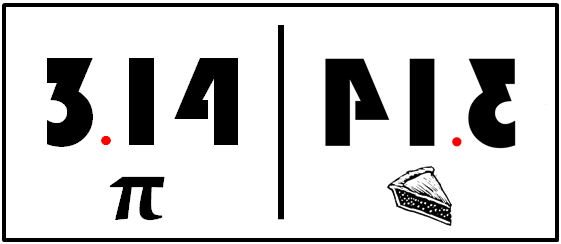
The Mirror Image of Pi is Pie...


Let's look closer at these four levels of meaning - P'shat, Remez, D'rash, and Sod; or Simple, Hint, Insight, Mystery.


P'shat (Simple) is where we all begin. Take the words of scripture at face value. There are certainly figurative passages, for example when God said to Israel "I bore you on eagles' wings" (Ex 19:4), keep in mind they walked. But mostly the text says what it says. One rule of Pardes is that a deeper level cannot contradict the plain meaning of a passage. For example, when Jesus said ""Do not think that I came to abolish the Law or the Prophets; I did not come to abolish but to fulfill." - Mt 5:18. You can't twist the word fulfill to mean that He did abolish the Law and the Prophets. "Fulfill" cannot contradict "not abolish".

P'shat implies to me that the text will be understood in any language, the Simple meaning will come through in a translation (531 languages so far - Wikipedia Bible Translations [6]). Not everyone has to be a Hebrew and Greek scholar.  It is my opinion that P'shat understanding is sufficient for salvation. However, understanding the text at face value is harder than it first appears, people disagree all the time over the Simple meaning of Biblical passages. According to David Barrett [7], Christianity has split into 33,000 denominations. I suspect most of the splits are over authority, not doctrine. The caution to all of us is to make sure you understand the Simple first.

Remez (hint or allegory). While the text has a Simple meaning, it alludes to something deeper. For example, Paul writes "For it is written in the Law of Moses, 'You shall not muzzle the ox while he is threshing.' God is not concerned about oxen, is He?" - 1 Co 9:9. Paul is saying plainly the text alludes to something more than oxen.

Events, places, things, and people are often "types" fulfilled later in history or prophecy. Here is another example by Paul, writing about Sarah and Hagar, "This is allegorically speaking, for these women are two covenants: one proceeding from Mount Sinai bearing children who are to be slaves; she is Hagar." - Gal 4:24. He comes out and says the two women are allegories of two covenants. Take that as a hint to look for other parallels between  Hagar typifying the Old Covenant and Sarah typifying the New Covenant. He continues the analogy by stating that Hagar is Mount Sinai and also the present Jerusalem, but Sarah is the new Jerusalem.

Parables are Remez. How many times did Jesus say "the kingdom of heaven is like ..."? One goal was to impart a truth (actually the point was to hide the truth Mt 13:10-11), another was to get the hearers to think. It is said that Jesus spoke to the crowds in Remez (Parable), but spoke to the Pharisees in P'shat (Simple). He spoke the D'rash (Search) only to His disciples, and the Sod (Mystery) only to James, Peter, and John - yesheva4me [2].

D'rash means to dig or to search. Pardes levels can overlap - just like Remez hints at a deeper meaning, something in a verse causes one to dig deeper. According to Wikipedia Midrash [8] "Presence of apparently superfluous words or letters, chronology of events, parallel narratives or other textual anomalies are often a springboard for interpretation of segments of Biblical text." yesheva4me [2] describes D'rash as "peering into the very core and nature of the individual words of the Bible by going back into the original languages, and other texts for the purpose of discovering and understanding intent and ideas." Yet others describe D'rash as a teaching or even a sermon, emphasizing the moral lessons revealed - yashanet [4].

Let me list several examples that might be Remez or D'rash. Perhaps it depends on how deep you dig.
  • Gen 22:3 "So Abraham rose early in the morning and saddled his donkey." Abraham is about to take his son Isaac to sacrifice him. Why does the Bible record a detail like "he saddled his donkey"? 
  • John 21:10 Jesus said to them, “Bring some of the fish you have just caught.” 11 So Simon Peter climbed back into the boat and dragged the net ashore. It was full of large fish, 153, but even with so many the net was not torn." After Jesus' resurrection, the disciples went fishing unsuccessfully till He came along telling them to throw the net on the right side of the boat. Why does it mention they caught 153 fish?
  • Gen 1:26 Then God said, “Let us make mankind in our image, in our likeness". This verse is a challenge for monotheists who believe God is one being. Who was He talking to then? It can't be the angels, because we are not made in their image.
Sod refers to a hidden or mystical meaning of the text, something not even hinted at by the Simple meaning of the words. Often Sod is associated with Gematria, using the numerical value of letters and words to "hyperlink" words and verses together. The most familiar example is the number or the Beast (666) in Rev 13:18.  Some say Gematria falls between D'rash and Sod. Gematria can be interesting, but also taken too far. Remember, Pardes cannot contradict the Simple meaning of the text. 

Some also teach that Sod is the Zohar of the Kabbalah, the secret of the mystical tradition - Shivim Panim  [5]. I think this leads one away from the intent of Pardes, which is to draw closer to God Himself. I don't believe that one has to seek mysticism to know God, who gives wisdom freely to all who ask - James 1:5.

yesheva4me  [2] argues that the four levels of Pardes correspond to breadth, and length, and depth, and height as desribed by the Apostle Paul in Ephesians. Have you ever wondered why there are four dimensions mentioned here? But notice Paul concludes by saying the love of Christ passes knowledge.

Ephesians 3
17 That Christ may dwell in your hearts by faith; that ye, being rooted and grounded in love,
18 May be able to comprehend with all saints what is the breadth, and length, and depth, and height;
19 And to know the love of Christ, which passes knowledge, that ye might be filled with all the fulness of God.

So What's That Got To Do With π?


One last example of Pardes, in keeping with Pi Day 2016. Consider the following verse.
"And he made a molten sea [tank], ten cubits from the one brim to the other: it was round all about, and its height was five cubits: and a line of thirty cubits did circle it round about". [Holy Scriptures, p. 412]

The observant reader will note that this implies π = 3. Every school child knows that's not (quite) right. Various mathematicians and historians have assumed the ancient Hebrews thought exactly that based on this verse - Belaga [9]. We have a hint (Remez) to dig deeper (D'rash). Possible explanations.
  • Priests aren't expected to know math. Except they did the calendar calculations.
  • The value of Ï€ wasn't known then. Except the Egyptians knew it before this.
  • The laver described was an ellipse. Nope, it says it was circular.
  • The value of Ï€ isn't the point of the story. True, but ...
  • Dig deeper.
Diving into the original Hebrew, we see the word line is translated from qaveh, but the margin says qav. The margin is what is read aloud, the text is what is written. Additionally, this verse is repeated word for word in 2 Chr 4:2, except that line is translated from qav not qaveh. Diving even deeper (Sod), the gematria value of qaveh is 111, value of qav is 106. The written value divided by the read aloud value becomes a correction factor for Ï€ = 3. The understanding of this correction factor is attributed to Rabbi Max Munk, 1962 - Belaga [9] (who gives much more detail than I give here). It is unclear whether Munk rediscovered it or whether it was passed on to him.

Ï€ = 3 x 111/106 = 3.1415094...

Remarkable isn't it? On a 10 cubit circle, the error in circumference (about 47 feet) from true π is about a half inch or ten millimeters.

Of course, it might be coincidence.

References

1. https://en.wikipedia.org/wiki/Pardes_(Jewish_exegesis)
2. https://guapotg.wordpress.com/2009/12/24/pardes-paradise
3. http://www.azlyrics.com/lyrics/crosbystillsnashyoung/woodstock.html
4. http://jlfreeman-1.blogspot.com/2016/02/diy-salvation.html
5. http://www.hebrew4christians.com/Articles/Seventy_Faces/seventy_faces.html
6. https://en.wikipedia.org/wiki/Bible_translations
7. http://www.philvaz.com/apologetics/a106.htm
8. https://en.wikipedia.org/wiki/Midrash
9. http://www.math.ubc.ca/~israel/bpi/bpi.html

Saturday, February 20, 2016

DIY Salvation

Indian Piercing Ritual 1908 [1]
In a TV show I watched recently, a man undertook a Native American ritual of self inflicted pain to "set things right in the universe". He suffered severe pain and deprivation to make amends for wrongs he had done, after which his daughter was healed. Of course, that's TV. But the notion of self inflicted pain for spiritual gain is not confined to Native Americans, it is in many religions. The Roman Catholic Church has a well developed theology concerning what they term penance. Usually, a priest would decide on the act of penance, also called epitemia. But it appears the more zealous can add to the penances.

Acts of self-discipline are used as tokens of repentance. Easier acts of self-discipline include devoting time to prayer or reading of the Bible or other spiritual books. Examples of harder acts of self-discipline are fasting, continence, abstaining from alcohol or tobacco, or other privations. Self-flagellation and the wearing of a cilice* are more rarely used. Wikipedia - Penance [2]
 *Cilice - a garment or undergarment made of coarse cloth or animal hair (a hairshirt) worn close to the skin

Other religions are mentioned in the Wikipedia article. The Eastern Orthodox Church practices penance similar to the Catholics without the confession to a priest. Anglicans practice confession and penance, so do Methodists. Apparently, Lutherans do not. To show how universal self inflicted pain for spiritual reasons, consider this.
Rituals of expiation and satisfaction appear in most religions, whether primitive or developed, as the means by which the religious person reestablishes or strengthens his relation to the holy or divine. Atonement is often attached to sacrifice, both of which often connect ritual cleanness with moral purity and religious acceptability. Britannica [3]
We see above two reasons for self inflicted pain, one is to make amends for one's sins, and two is to gain spiritual favor, insight, or closeness to God. Does it work? Is God pleased with flagellants? [4] It appears self inflicted pain makes the person feel less guilty. In an experiment with college students, Dr Bastian of The University of Queensland observed this.
Humans have been socialised over ages to think of pain in terms of justice. We equate it with punishment, and as the experimental results suggest, the experience has the psychological effect of rebalancing the scales of justice and therefore resolving guilt. Medical Xpress [5]
But logically, the person who self-inflicted pain is exactly as guilty as they were before the pain - they only felt less guilty. Say one breaks a traffic law, like running a stop sign, does contrition and remorse or even pain make them any less guilty? No.

Does this "Do It Yourself Atonement" work? Can I make it right with the universe by inflicting pain on myself? Can I do acts of charity to balance out the score? In my own life, I have committed plenty of wrongs I would like to right, many people I've hurt, beginning with my parents. I wish I could say that was before I began to believe in God and believe God, before striving to live by His word, that is, before I knew Him. But I've committed wrongs since then I would like to undo. And in many ways those hurt me more, because I should know better, because I've let my Father down, and I want to make it up to Him. So, how do we make it right with God?

It's All About the Tabernacle


It may surprise you that the Tabernacle of ancient Israel is a template of how to approach God, and it is full of other symbolism as well. To approach God, who dwelt in the innermost part of the Tabernacle, called the Holy of Holies, one entered the Tabernacle through its only door, on the east side. That door is Jesus Christ, "I am the door of the sheep." - John 10:7,9. "And there is salvation in no one else; for there is no other name under heaven that has been given among men by which we must be saved" - Acts 4:12. The first item one encounters in the Tabernacle is the bronze altar, used for animal sacrifices. You can't go any further towards the Holy of Holies till a sacrifice is made.


But the Bible is very specific about the sacrifices, a lot of "column inches" are devoted to them. The point here is that it is not a do-it-yourself sacrifice. You and I don't get to decide the sacrifice God must accept. Sacrifices were substitutions, an animal's life instead of a human. These sacrifices ultimately picture Jesus, substituting Himself, that is some aspect of His life and ministry, for us. And the priest who performed the sacrificial ceremony also pictures Jesus, especially the High Priest. It's all about Jesus' sacrifice, not ours.

What about fasting? It is a voluntary self denial (mandatory on Yom Kippur), a kind of self inflicted pain. Fasting is known in the KJV Bible as "afflict your soul", it's not talking about a health fast. But fasting is not about making the universe right. Fasting is not a hunger strike to get your own way from God. Fasting tells God that His ways are more important to you than food itself. Fasting is about humbling your self. Then He will restore you, read Isaiah 58:1-11 below. 

So people have the rightful notion that a sacrifice is the first step towards reconciliation with God, but we have twisted that sacrifice to be one of our own choosing. Self inflicted pain may make us feel less guilty, but it is Jesus sacrifice that actually makes it so. I want to make it up to God, I'm disappointed in myself for letting him down. I think this impulse is in all of us based on the fact that all religions have some sort ritual of expiation as explained above. This may be why we have an intuitive notion of sacrificing in order to reconcile with God. But there are many wrongs we can't right. The obvious examples would be things like murder or crippling someone. We can't reconcile with people who have passed away. We can't take back adultery, etc. Alcoholics Anonymous Step 9 says "Be willing to make amends" AA [6]. And the Bible says "Bring forth fruits in keeping with your repentance" -  Mt 3:8. Yes we should make amends, but we can't fix everything. We can't do it all ourselves.

Jesus did the heavy lifting. Our part is to "repent and believe the gospel" - Mark 1:15. As a nation, we've got a lot of repenting to do. Then live in such a way as to "present our bodies a living sacrifice, holy, acceptable unto God, which is your reasonable service" - Rom 12:1.


Isaiah 58:1-11
 
1 Cry loudly, do not hold back;
Raise your voice like a trumpet,
And declare to My people their transgression
And to the house of Jacob their sins.
2 Yet they seek Me day by day and delight to know My ways,
As a nation that has done righteousness
And has not forsaken the ordinance of their God.
They ask Me for just decisions,
They delight in the nearness of God.
3 ‘Why have we fasted and You do not see?
Why have we humbled ourselves and You do not notice?’
Behold, on the day of your fast you find your desire,
And drive hard all your workers.
4 Behold, you fast for contention and strife and to strike with a wicked fist.
You do not fast like you do today to make your voice heard on high.
5 Is it a fast like this which I choose, a day for a man to humble himself?
Is it for bowing one’s head like a reed
And for spreading out sackcloth and ashes as a bed?
Will you call this a fast, even an acceptable day to the Lord?
6 Is this not the fast which I choose,
To loosen the bonds of wickedness,
To undo the bands of the yoke,
And to let the oppressed go free
And break every yoke?
7 Is it not to divide your bread with the hungry
And bring the homeless poor into the house;
When you see the naked, to cover him;
And not to hide yourself from your own flesh?
8 Then your light will break out like the dawn,
And your recovery will speedily spring forth;
And your righteousness will go before you;
The glory of the Lord will be your rear guard.
9 Then you will call, and the Lord will answer;
You will cry, and He will say, ‘Here I am.’
If you remove the yoke from your midst,
The pointing of the finger and speaking wickedness,
10 And if you give yourself to the hungry
And satisfy the desire of the afflicted,
Then your light will rise in darkness
And your gloom will become like midday.
11 And the Lord will continually guide you,
And satisfy your desire in scorched places,
And give strength to your bones;
And you will be like a watered garden,
And like a spring of water whose waters do not fail.


References
1. http://historic.al/image/apsaroke-indian-man-during-a-piercing-ritual-1908-black-and-white-by-jvpd-7372
2. https://en.wikipedia.org/wiki/Penance
3. http://www.britannica.com/topic/atonement-religion
4. https://en.wikipedia.org/wiki/Flagellant
5. http://medicalxpress.com/news/2011-05-self-inflicted-pain-eases-guilt.html
6. http://www.alcoholic.org/research/aa-step-9/


Thursday, January 21, 2016

The French Connection

The day of the Shemitah [1] came and went. Skeptics feel justified in their skepticism, that life goes on just as it did before. Or in Bible language "For ever since the fathers fell asleep, all continues just as it was from the beginning of creation." 2 Peter 3:4 Maybe one needs to look in the right place for events associated with the Shemitah, which according to Jonathan Cahn was Sept 13, 2015. While the focus of the Shemitah warnings were given to America, perhaps we should also look at Israel.


Al Aqsa Mosque - ITV


ITV REPORT 13 September 2015 at 9:12am [2]

Violence breaks out at al-Aqsa mosque as Israeli forces storm building in search of Palestinian suspects


I have to admit that's not the shaking I expected, in fact Israeli/Palestine conflicts don't seem unusual. What happened next? Due to the violence, a month later France proposed the UN place "international observers" on the Temple Mount - World Bulletin [3]. You can read a more cynical take on France's proposal in this article entitled "This Time Peacekeepers Won’t Rape Anyone, We Promise" - PreOccupied Territory [4]. The proposal did not pass the UN. And Israel opposed it. United With Israel [5] characterized the proposal with the headline "France stabs Israel in the back". It appears France is assuming Israel is the guilty party.

This isn't the first move France has taken against Israel at the UN. In Dec 2014, France supported establishing "the State of Palestine" and requiring Israel to return land captured in the 1967 war - RT News [6]. In fact the French Parliament had already recognized Palestine earlier.

On Tuesday evening, the French National Assembly came out in favor of recognition of “Palestine” as a state. The decision, one of largely symbolic value, is further compounded by the fact that in recent months Spain, Britain, Ireland and Sweden have also made similar proclamations, indicative of the growing international polarization over the conflict. Dec 3, 2014 - United With Israel [7]

And the Palestinians? Their goal is to destroy Israel. Here is what Mahmoud Abbas said on Sept 16, 2015, three days after violence erupted on the day of the Shemitah.

The Al Aqsa mosque is ours and they (Jews) have no right to defile it with their filthy feet. We will not allow them to do so. We bless every drop of blood that has been spilled for Jerusalem, which is clean and pure blood, blood spilled for Allah, Allah willing. Every martyr will reach paradise, and everyone wounded will be rewarded by Allah. MEMRI TV [8]
 In short, Allah will bless you for your violence (against Israel). And this is no surprise, remember that the HAMAS charter really does call for the destruction of Israel - Hamas in the Bible [9].

As You Do To Israel


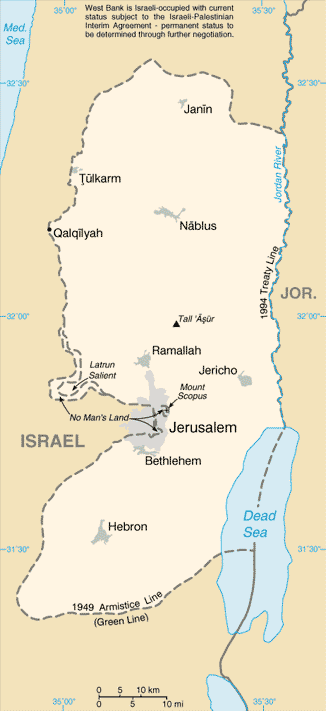
Israel's West Bank
Wikipedia
Israel has been dealing with hostile neighbors from its second beginning in 1948. Acts of terrorism and threats of terrorism are ever present dangers for them. But there is a reciprocity effect also in play. Way back before Jews or Palestinians existed, God said to Abraham, "And I will bless those who bless you, And the one who curses you I will curse. And in you all the families of the earth will be blessed." Gen 12:3. Those who try to harm Israel will themselves be harmed, probably in like manner. Those who tried to take land from Israel lost theirs instead, twice. Here is how one commentor put it.

Try to destroy Israel, you will be destroyed. Try to divide Jerusalem, you will be cut to pieces. Curse Israel, you will be cursed. Reject Israel, you will be rejected. God made a promise to Israel, this World combined are too weak and powerless to change that. Russel Lang - Times of Israel [10]


The Eiffel Tower has gone dark following 
the attack on the City of Light. 

France too has been dealing with terrorist incidents, most infamous are the Charlie Hebdo and Kosher Market [11] killings Jan 7, 2015, and the November 13 2015 Paris [12] attacks. Smaller terror attacks are recorded at Wikipedia [13]. Note the pattern that one month after France recognizes the "State of Palestine" is the Charlie Hebdo attack. One month after proposing UN peacekeepers on the Temple Mount is the November Paris attack (and that was a response to the Day of Shemitah violence in Jerusalem). Curse Israel, and be cursed yourself.


Where is the terror coming from?


Historically, the Assyrians are the fathers of terror. According to The Ancient History Encyclopedia  [14]

"By these methods of siege and horror, technology and terror, the Assyrians became the unrivalled masters of the Near East for five centuries". 


Here's how Jonathan Cahn described them.
The Assyrians made terror into a science. They systematized it, perfected it, and employed it as no other people or kingdom had ever done before. They burned cities to the ground, mutilated their prisoners, flayed alive those who rebelled against them, and nailed their skins to the wall for public display. The Assyrians were the masters of terror.” The Harbinger [15]

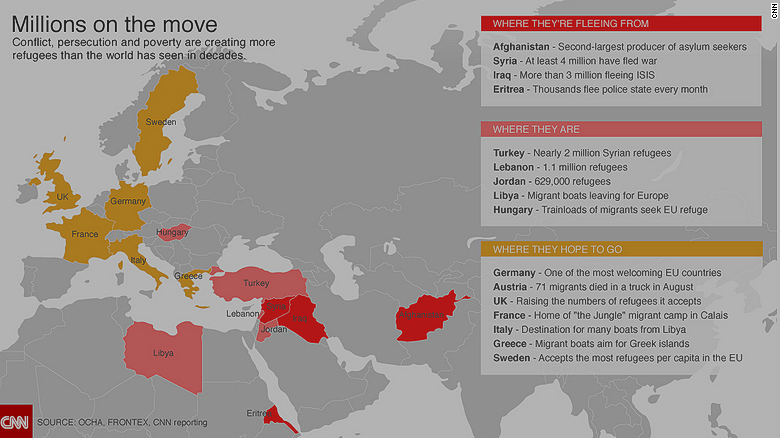
While there is some disagreement on this point, but the consensus is that the descendants of ancient Assyria live in Iraq and Syria today. ISIS means Islamic State of Iraq and Syria. Ancient Assyria terrorized ancient Israel and Judah, their descendants are doing the same to Israel, France, the USA, Germany, Sweden, and more today. Ancient Assyria used public beheadings to terrorize, ISIS uses the internet to publicize their beheadings.

The French Connection


Syrian Refugees in Europe CNN
It may sound alarmist to link two terrorist attacks in France to the actions of France towards Israel, after all it's not much of a pattern. However, William Koenig [16] in his book "Eye To Eye, Facing the Consequences of Dividing Israel" [17] documented 89 events and catastrophes in the United States between 1991 and 2005. These are natural disasters like floods, earthquakes, hurricanes, tornadoes; and unnatural disasters like terror attacks, downed airplanes, anthrax scares. The catastrophes have not stopped since the book was published, and seem to have intensified since the day of the Shemitah. Every one of the events and catastrophes in Koenig's book can be tied to a US action against Israel, most notably pressuring Israel to trade "land for peace".

Koenig documented US disasters only, but consider terror attacks in London, Madrid, and now Paris. Could they be the direct result of siding against Israel, pressuring Israel to trade land for peace? Cahn describes the terror as a return of the second harbinger. You can watch his analysis here - Shocking France and Harbinger Connections [18]. If the concern over terror attacks seem exaggerated, consider that there have been 27,649 deadly Islamic attacks since 9/11/2001, not counting rapes. Twenty seven thousand!!! The Religion of Peace [19]

How to Heal the Land


A nation that turns its back on God, and tries to curse Israel, can only expect God to return the favor. The only answer is repentance on a national scale. Whether the nation repents or not, individuals can.

A prudent man foreseeth the evil, and hideth himself; but the simple pass on, and are punished. Proverbs 22:3 and Proverbs 27:12
If my people, which are called by my name (Christians), shall humble themselves, and pray, and seek my face, and turn from their wicked ways; then will I hear from heaven, and will forgive their sin, and will heal their land. 2 Chron 7:14

References

1. http://jlfreeman-1.blogspot.com/2015/07/shemitah-she-what.html
2. http://www.itv.com/news/2015-09-13/violence-breaks-out-at-al-aqsa-mosque-as-israeli/
3. http://www.worldbulletin.net/news/165369/france-pushes-for-intl-troops-on-temple-mount
4. http://www.preoccupiedterritory.com/this-time-peacekeepers-wont-rape-anyone-we-promise/
5. http://unitedwithisrael.org/france-stabs-israel-in-the-back-at-un/
6. https://www.rt.com/news/251833-middle-east-un-peace-israel/
7. http://unitedwithisrael.org/french-parliament-recognizes-palestinian-state/
8. http://www.memritv.org/clip/en/5080.htm
9. http://jlfreeman-1.blogspot.com/2014/08/hamas-in-bible.html
10. http://www.timesofisrael.com/france-preparing-draft-for-un-resoluton-on-palestine/
11. http://www.cnn.com/2015/01/13/middleeast/paris-kosher-store-funeral/index.html
12. http://www.cnn.com/2015/01/13/middleeast/paris-kosher-store-funeral/index.html
13. https://en.wikipedia.org/wiki/List_of_terrorist_incidents_in_France
14. http://www.ancient.eu/Assyrian_Warfare
15. http://www.amazon.com/The-Harbinger-Ancient-Mystery-Americas/dp/161638610X
16. http://www.watch.org/
17. http://www.amazon.ca/Eye-Facing-Consequences-Dividing-Israel/dp/0971734704
18. https://www.youtube.com/watch?v=D10qrKK9xwA
19. http://www.thereligionofpeace.com/ 


Thursday, January 7, 2016

Was Jesus Angry at the Leper?

In Mark 1:41, we read a story of Jesus healing a leper, simple enough on the surface, but with a puzzling aspect.

40 And a leper came to Jesus, beseeching Him and falling on his knees before Him, and saying, "If You are willing, You can make me clean." 41 Moved with compassion, Jesus stretched out His hand and touched him, and said to him, "I am willing; be  cleansed."

In some of the most reliable Greek manuscripts, verse 41 reads

Becoming angry, Jesus stretched out His hand and touched him, and said to him, "I am willing; be cleansed."

That's quite a difference, "moved with compassion" versus "becoming angry". One translation says "Jesus was indignant". It's not a simple copyist error, the  ancient version of a typo. Some manuscripts say SPLANGNISTHEIS, some say ORGISTHEIS Misquoting Jesus [1]. Typical copyist errors include misspelled words, missed or added letters, even a whole line could be skipped or duplicated. But it is too much to think SPLANGNISTHEIS was miscopied as ORGISTHEIS  or vice versa.  Is it even possible to know the intent?

Leprosy 101


What is leprosy anyway? The disease leprosy that we are familiar with in the modern world is called Hansen's disease, named after G. H. Armauer Hansen, who discovered the causative bacteria in Norway in 1873 Wikipedia [2]. Hansen's Disease is somewhat preventable with a vaccine and quite treatable with antibiotics.

But Biblical leprosy appears not to be Hansen's Disease, though some include Hansen's Disease under the Biblical definition of leprosy. Leprosy is translated from the Hebrew word tsara'ot. "The Hebrew word for leprosy is tzaraath which is derived from the word tsara, which means to be struck. To be struck, is to be affected by something overwhelming, in which a primitive root of "tsara" means to scourge, which to scourge means to whip or inflict punishment" Chaim Bentorah [3].

Biblical leprosy is a broader term than the leprosy (Hansen’s disease) that we know today. The Hebrew tsara’ath included a variety of ailments and is most frequently seen in Leviticus, where it referred primarily to uncleanness or imperfections according to biblical standards. A person with any scaly skin blemish was tsara’ath. The symbolism extended to rot or blemish on leather, the walls of a house, and woven cloth. Other Old Testament references to leprosy are associated with punishment or the consequences of sin.  
Others have suggested that the translation of tsara’ath includes “molds.” The recent discovery of a highly toxic mold (Stachybotrys sp.), which contaminates buildings and causes respiratory distress, memory loss, and rash, lends support to the translation of tsara’ath to include “mold.” As noted, tsara’ath incorporates a collection of contemporary terms, including Hansen’s disease, infectious skin diseases, and mold (or even mildew) diseases. Biblical Leprosy [4]


The fact that it can extend to leather or cloth or even houses suggests it is more than Hansens's Disease. Strong's simply defines tsara'ot as "perhaps some fungus or mould" Strong's [5].  And Wikipedia [6] argues "Tzaraath is sufficiently dissimilar from leprosy to be considered a different disease altogether"

Translators, Again


How did tsara'ot become associated with Hansen's Disease? It's not entirely clear, but part of the answer is that tsara'ot was translated as "lepra" in the Septuagint, a Hebrew to Greek translation of the Old Testament done before Christ was born. Hebrew to Greek, Greek to English, and tsara'ot became leprosy. Only problem is that lepra didn't mean leprosy as in Hansen's Disease Jewish Encyclopedia [7]. Nonetheless, nowadays Biblical tsara'ot is confused with leprosy.

Shun Me


Sufferers of tsara'ot were forced to live outside the camp, a sort of quarantine. They were diagnosed by the Levitical priests, and it was also the priests who allowed them back into the camp if they were cleansed. Being forced to live outside the camp gave rise to the other meaning of leper, that of outcast. But tsara'ot meant something more in that culture - punishment. "The Talmud, and the majority of historic Jewish literature in general, regards tzaraath as a punishment for sin" Wikipedia [6].  "Every leper mentioned in the Old Testament was afflicted because of some transgression" Jewish Encyclopedia [7].  In the eyes of the community, those with tsara'ot were being punished for sin, they deserved it. In modern parlance "you must have done something". In the church today, do we look at a person with health problems and think to ourselves, "he must have done something"? Do we shun that person? Treat them like a leper?

The Bible doesn't actually say that tsara'ot is always punishment for sin however.  According to the historic sources, tsara'ot is the result of certain sins, chief among them "an evil tongue" or gossip. But why would gossip have such a severe penalty? We understand that everyone sins, we should all have tsara'ot or worse. If someone you know is cast out of the camp for tsara'ot, do you look down on them because they must have done something, or feel compassion because you are guilty too?

WWJD


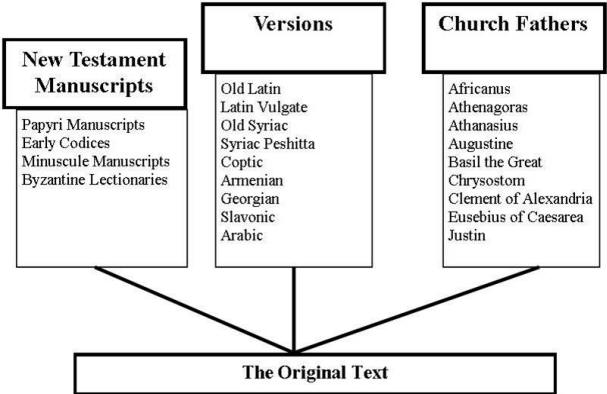
What would Jesus do? What did Jesus do? So far, we know he either felt compassion or was angry with the metsora, the one impure with tsara'ot. We saw that the New Testament manuscripts disagree on one word in Mark 1:41. How do we know which is right? The people who study the ancient manuscripts are called textual critics. Since the original letters penned by the authors don't exist anymore, all we have are copies of copies of copies (at best). The early copyists made mistakes as well as deliberate changes to "improve" the text, at least improve it according to their own thinking. We do have 5700 manuscripts of the New Testament, some are only fragments the size of a postcard, others are complete copies. We also have early church writers who quoted those original documents. Sadly, there are tens of thousands of discrepancies  among the manuscripts. Hence the job of textual critics is to seek out the words of the original authors.  In 85% of the cases, the correct reading is straightforward, a simple copyist error that got propagated by later copyists. Sometimes, like Mark 1:41, it isn't so easy to tell what did Mark actually write.


Critics look at lots of factors to make their educated guesses, age of manuscripts, reliability of manuscripts, etc. One factor is to ask which reading best explains the existence of the other. Bart Ehrman explains:

The question to be asked is this: which is more likely, that a scribe copying this text would change it to say that Jesus became wrathful instead of compassionate, or to say that Jesus became compassionate instead of wrathful? Which reading better explains the existence of the other? When seen from this perspective, the latter is obviously more likely. The reading that indicates Jesus became angry is the “more difficult” reading and therefore more likely to be “original.” Misquoting Jesus [8]

Mr. Ehrman has lots more to say about Mark 1:41, as well as other problematic texts. His book is well worth reading. It is easier for us to think of Jesus as feeling compassion to heal the metsora. It appears Matthew and Luke thought so too because in their accounts, they omit any mention of Jesus' emotional reaction (Mt 8:1-4, Lk 5:12-15). Critics believe that Matthew and Luke wrote their gospels from Mark's, that is, they had Mark's letter in hand and copied much of it word for word, making their own changes for their own reasons. If that is true, neither of them wanted to mention Jesus' anger, but didn't go so far as to change the text to say compassion. Some copyist centuries later probably did.

WWJD (Why Would Jesus Do That?)


Assuming Mr. Ehrman is correct, we now have two problems. 1) The wrong text was used  for centuries (not that it affects anything significant), and 2) we now have to ask what it means that Jesus was angry at the leper. Or in Ehrman's words, "At what, though, would Jesus be angry? This is where the relationship of text and interpretation becomes critical." Misquoting Jesus [9]. Some scholars think Jesus was angry at all the disease in the world, some think He was angry the metsora was outcast, some think He was angry at the law of Moses. These theories don't really hold water. Ehrman's explanation is that Jesus was angry at the inference in the question of the metsora, "If you are willing, You can make me clean." Jesus was willing and able. The times Mark records Jesus being angry, it is when someone questioned his willingness, ability, or authority.

Maybe we assert doubt by asking "If you're willing". Although it sounds to me like a valid question, maybe it is actually expressing doubt.  After all, we are to "come boldly to the throne of grace, that we may obtain mercy and find grace to help in time of need" Heb 4:16. On the other hand, Jesus Himself prayed "Father, if You are willing, remove this cup from Me; yet not My will, but Yours be done." Lk 22:42 On the third hand, SPLANGNISTHEIS may have meant something different to Mark than it did to the copyist centuries later, so he really did improve the text for later generations.

Was Jesus angry at the leper? Why? Do any of these theories ring true to you? I would invite your comments.

References

1. http://www.amazon.com/Misquoting-Jesus-Story-Behind-Changed/dp/0060859512, Kindle Location 2134
2. https://en.wikipedia.org/wiki/Leprosy
3. http://www.chaimbentorah.com/2013/02/word-study-leprosy/
4. https://answersingenesis.org/biology/disease/biblical-leprosy-shedding-light-on-the-disease-that-shuns/
5. http://biblehub.com/hebrew/6883.htm
6. https://en.wikipedia.org/wiki/Tzaraath
7. http://jewishencyclopedia.com/articles/9774-leprosy
8. http://www.amazon.ca/Misquoting-Jesus-Story-Behind-Changed/dp/0060859512, Kindle Locations 2162-2166

9. http://www.amazon.ca/Misquoting-Jesus-Story-Behind-Changed/dp/0060859512, Kindle Locations 2197-2198

Friday, December 4, 2015

Ten Little Known Facts About the Ten Commandments

The Ten Commandments are famous. Many Christians will know them by heart, at least the short form of each. Non Christians will even know some of them, or at least be aware they exist. Jewish people certainly know them. But how well do we know them? Can you recite them in their short form? In their long form? Is there more to them than just memorizing the list? See how many of these "little known facts" about the Ten Commandments you already knew.

1. They Aren't Called The Ten Commandments in the Bible

That's right. The Hebrew scriptures don't call the Ten Commandments the Ten Commandments. The Hebrew word for commandment is mitzvah, plural is mitzvot. But when it refers to these it calls them the Ten Words (Aseret ha Devarim), not Aseret ha Mitzvot. Of course, Devarim means words in the broader context, not literally ten words. We might say, "what's the good word?" not expecting a one word answer. Or we might say "spread the word", meaning a thought or saying, not just one word.

The Ten Words are listed in their entirety twice in the Bible, Ex 20 and Dt 5. Neither passage breaks them into a numbered list. In fact, if you read it without knowing there were ten sayings, you might find more like 13 or 14. Numbering them is discussed below. So how do we know there are ten? The Bible tells us so in three places, let's look at one. Moses is rehearsing the events from Egypt to the Promised Land for the people of Israel, he says this.

Dt 10:4 And he wrote on the tablets, in the same writing as before, the Ten Commandments[a] that the Lord had spoken to you on the mountain out of the midst of the fire on the day of the assembly. And the Lord gave them to me.
[a] Deuteronomy 10:4 Hebrew words 


So we know there are ten, we know the text doesn't number them, and we know they are not called commandments but rather words. Then there must be at least one word that is not a commandment, a devar that is not a mitzvah.


2. God Introduces Himself


Consider the first thing God said to the whole nation of Israel, not to Moses alone.

Ex 20:1 I am the Lord your God, who brought you out of the land of Egypt, out of the house of slavery.


 After centuries of slavery, it is unlikely many if any knew God. There is some indication they knew His name, which He actually used in verse one, saying "I am Yehovah". [insert your own argument about spelling and pronunciation of YHVH here]. In many of the numbering schemes, this Word is tacked on as an introduction to the first Commandment. While this may be logical, in the Hebrew reckoning, verse one stands alone as the first Word. And you can see, it is not a commandment. It is an introduction to the entire Ten Words, not the first actual commandment.

The New Testament does refer to commandments. In Mt 19, a man comes to him and asks "Good Master, what good thing shall I do, that I may have eternal life?"  Christ tells him to keep the commandments (Greek entole). By Hebrew reckoning, there are 613 commandments (mitzvot) in the Torah, so it is understandable that the man asked "which ones?" And Christ answers by listing five of the Ten Words plus the famous line "Thou shalt love thy neighbor as thyself", which may be implied in the Ten Words, but is not explicitly in the text of Ex 20.

According to Jeff Benner, writing for the Ancient Hebrew Research Center [1], a more accurate meaning of entole is the same as Hebrew mitzvah, which is precept, or principle, but is usually translated as commandment.


3. How the Ten Words Are Numbered


Well, it depends on who you ask. As I showed above, there is disagreement right from the first Word. Some include it in the numbering, some do not. The disagreements continue with the second and third words. Some split "Thou shalt have no other gods before Me" and "Thou shalt not make unto thee a graven image" into two Commandments, while others make it into one. Apparently the Lutherans omit graven images altogether. Then there is fair agreement till the Word about coveting - is it one or two commands? Here is a chart from Sunday Software showing the major variants [2]. Wikipedia [3] has an even more comprehensive chart on the numbering.


4. How Are the Ten Words Divided?


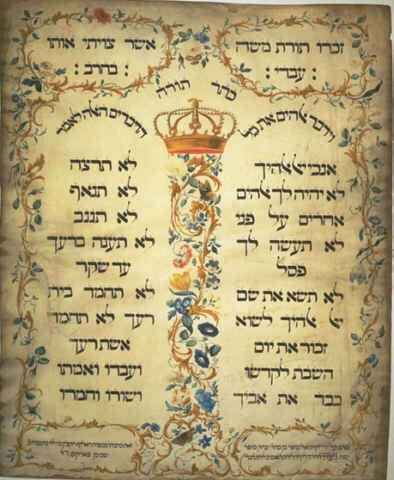
Many churches teach that the first four Commandments show how to love God, and the last six show how to love your neighbor. That's not a bad way to look at them, but it's not the only way. The parchment at left depicts the two tablets as having five on the left, five on the right. The Word in question, the fifth Word, is "Honor thy father and mother".  How does honoring parents fit with the first four Words more than the last five? The first five Words make us look up, the second five make us look eye to eye. It's like two hands, one with fingers pointing vertically, one with fingers pointing horizontally. Writing in Mosaic Magazine [4], Leon Kass has a lot to say about the fourth and fifth Words, Keep the Sabbath, and Honor your Parents. He likens the upward focus on parents as the "embodiment of, and our first encounter with, the gracious beneficence of the world— and of its bountiful Source", that parents "embody and model the Lord God of Israel". In other words, to a child, parents are like gods. Another quote from Kass:
The experience of awe before parents is the germ of the religious disposition; for within God’s covenant, parents stand as representatives of divine authority and care, and the honor and reverence they are owed has purposes beyond family integrity and stability. Indeed, as I pointed out, honoring and fearing/ revering mother and father are, at once, paths toward and manifestations of the holiness to which the children of Israel are called, in imitation of God Himself.

In other words, authority begins with parents.

5. The Words are Second Person Male


What do I mean by that? I have been quoting the King James here because King James English expresses something modern English can't, specifically, there is a difference between Ye and Thou. In modern English we use the word You to speak to a man, a woman, or a group of people. But in Old  English, you could differentiate your audience a little. "Thou shalt not kill" means something different from "Ye shalt not kill". Thou is singular, Ye is plural. When Jesus said "Drink ye all of it", he meant for everybody present to drink.

But it is even more precise than that in the Old Testament. Hebrew distinguishes when addressing single male (atah), single female (at), group of males (atem), and group of females  (aten). That is, the single word You in English may be translated from one of four Hebrew words. Old English can at least distinguish between single and plural, modern English not at all. Unless you're from the South, where y'all is singular and all y'all is plural.

The Ten Words use second person male (atah). That's right, they are addressed to the men. No that doesn't mean women are exempt - consider adultery, both the man and the woman were stoned to death. I think it may have more to do with the patriarchal structure of ancient Israel.

But it also means that God spoke these Words to each individual. Millions of people were on Mt. Sinai that day, and God effectively spoke to each one personally. And He is speaking to each one of us today. And that personal message still comes through in the King James "Thou shalt not ..."


6. Synesthesia


There's a puzzling verse in Exodus immediately after God spoke the Ten Words. It says (Ex 20:18)
And all the people saw the thunder, and the lightning, and the noise of the trumpet, and the mountain smoking: and when the people saw it, they removed, and stood afar off.


Usually, we focus on the fact that the people were afraid and removed themselves. But look at what it says "the people saw the thunder". How can this be? According to Rabbi Rashi [5], a medieval French rabbi, it is not a mistranslation. It was an intense revelation from God. Rabbi Akiba [6] "They saw what was audible and heard what was visible". It was mass synesthesia Seeing the Sounds [7]. Synesthesia means "union of the senses" Wikipedia [8]. Carol Steen, co-founder of the American Synesthesia Association sees sounds as color. She said simply "We see it in our mind's eye." Pitchfork [9] ,

Extra-Biblical sources add some other details on this mass synesthesia event. 

Rabbi Akiba again
They saw the fiery word coming out of the mouth of the Almighty as it was struck upon the tablets. Torah Class [10]

Rabbi Johanan [11] 

every nation heard the voice in its own tongue and was amazed Coming Home Network [12]

Words of fire. In their own tongue. That sounds exactly like the New Testament Day of Pentecost, sometimes referred to as Second Sinai. Indeed, most agree that the Giving of the Ten Words happened on the Day of Pentecost.  Note that on the OT Pentecost (Shavuot), the Words were written on tablets of stone, but in the new covenant, the Words will be written on our hearts and minds [Jer 31:33]. To be clear, it is the same Ten Words that will be written on our hearts and minds that ancient Israel received on Sinai on that day of Pentecost.

We accept the old adage "seeing is believing", but the Bible also says that "faith comes by hearing". Many, like Rabbi Dov Ber Weisman [13] liken seeing to the physical and hearing to the spiritual. God's voice, His words, were so powerful, the experience so transcendent, that it crossed from spiritual to physical. By being visible, the Words became all the more real to the hearers.


7. The Ten Words Are The Old Covenant


Let's look at one of the other places Moses uses the phrase "Aseret ha Devarim", the Ten Words, in Ex 34:28 "And he wrote on the tablets the words of the covenant, the Ten Commandments." Actually there is more to the covenant than just the Ten Words, read all of Exodus 21-24. The Ten Words are the only part that God spoke to all the people. In Ex 24 the people said "All the words which the LORD has spoken we will do!"

This was the first time God made a covenant with a nation. Before this, he had made covenants with individuals, like Adam and Eve, Noah, Abraham, Isaac, and Jacob. But now He made a nation of Jacob's descendants and made a covenant with them. The children of Israel had to obey the voice of God, in return, God promised them this:

Ex 19:5 Now if you obey me fully and keep my covenant, then out of all nations you will be my treasured possession. Although the whole earth is mine, 6 you will be for me a kingdom of priests and a holy nation.'
But it was more personal than that. It was also a marriage covenant.


Jer 31:32 Not like the covenant which I made with their fathers in the day I took them by the hand to bring them out of the land of Egypt, My covenant which they broke, although I was a husband to them," declares the LORD.

Treasured possession, kingdom of priests, holy nation, and wife. Today, we understand that the church is to be the bride of Christ, but that idea is very old. Many more blessings are promised elsewhere like Lev 26 and Dt 28, but Ex 19:5 shows what the people were promised less than two months after deliverance from Egypt and slavery. And they said YES. But we know it didn't last even the forty days while Moses was on the mountain receiving the tablets of stone, which brings us to:


8. The Meaning of the Broken Tablets


Now that we understand that the Ten Words are a covenant, the symbolism of Moses breaking the tablets is easy to see. The tablets represented the covenant which Israel broke while Moses was on the mountain. They broke the covenant, Moses broke the tablets.


9. What Was Written on the Stone Tablets?


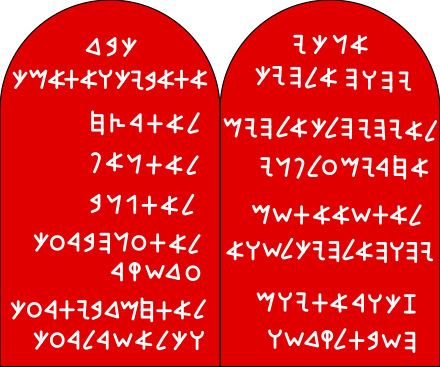
Above I showed a graphic of the Ten Words with five Words on each tablet, but the Bible says 

Ex 32:15 And Moses turned, and went down from the mount, and the two tables of the testimony were in his hand: the tables were written on both their sides; on the one side and on the other were they written.

The Ten Commandments (shortened version)
 written in 10th century BC characters,
like on Cecil B. DeMille's tablets in the movie.
Wikipedia "The Ten Commandments (1956 film)"
 Some Jewish writers claim that the text went all the way through from both sides, including letters with holes in them. I'm skeptical. But why writing on both sides? Maybe the Words are written out in long form, not just the summaries, and it required that much space. We don't know exactly how big the tablets were, other than the fact that they fit in the ark of the covenant, and were carried by an 80 year old man. Another plausible explanation is that there were two copies. Since the Ten Words formed a covenant (similar to a contract), two copies were required. It is standard practice for each party to a contract to receive a copy for proof of what each agreed to. No cheating. But why would God give both copies to Israel? The first set of tablets were broken, the second set lost to history, so we can't just look and see. Someday...

10. Sign of the Covenant


God made a covenant with Noah to not destroy the earth by flood. He gave the rainbow as a sign of His word. God made a covenant with Abraham to make his descendants a great nation. He gave circumcision as a sign. The covenant with Noah (and his descendants) was unconditional - there was nothing Noah could do to "set the bow in the cloud", but the covenant with Abraham (and his descendants) was conditional, in that Abraham  (and his descendants) had to do something - circumcision. 

What is the sign of the Old Covenant? The consensus is that the Sabbath is the sign of the Old Covenant, even by people who believe it was done away in the New Covenant. Everyone cites Ex 31:12-17

16 Wherefore the children of Israel shall keep the sabbath, to observe the sabbath throughout their generations, for a perpetual covenant.
17 It is a sign between me and the children of Israel for ever: for in six days the LORD made heaven and earth, and on the seventh day he rested, and was refreshed.
18 And he gave unto Moses, when he had made an end of communing with him upon mount Sinai, two tables of testimony, tables of stone, written with the finger of God.

Some (like me) view Sabbath keeping as essential, as John G. Reisinger wrote "To break the sign is to despise the entire covenant"  Sabatismos [14], and Sabbath breaking is one reason the Israelites who left Egypt died in the wilderness without entering the promised land. Ezek 20:


15. Yet also I lifted up my hand unto them in the wilderness, that I would not bring them into the land which I had given them, flowing with milk and honey, which is the glory of all lands;
16 Because they despised my judgments, and walked not in my statutes, but polluted my sabbaths: for their heart went after their idols.
17 Nevertheless mine eye spared them from destroying them, neither did I make an end of them in the wilderness.

Others (not me) argue it is no longer in force. Others argue that the Sabbath command in Ex 31 was a separate covenant apart from the Ten Words, ie Old Covenant  Forerunner Commentary [15]. As proof, they argue that the Old Covenant had already been ratified and therefore could not be modified, so the Sabbath covenant is a separate one. However that leaves the original question "what is the sign of the Old Covenant?" All roads lead to the conclusion that the Sabbath IS the sign of the Old Covenant, separate covenant notwithstanding. It is part of the New Covenant as well. The Sabbath is an identifying mark, "a sign between Me and the children of Israel for ever." But don't let anyone tell you it was only for Israel - Christ said the Sabbath was made for mankind. If you wish to be under the Old or the New Covenant, you must keep the Sabbath.

The Ten Words and the Covenants are very important in the Bible. These aren't the only little known facts about them. There are many other facts about the Ten Words. Perhaps you have some you would like to share in the comments.

References

1. http://www.ancient-hebrew.org/50_command.html
2. http://www.sundaysoftware.com/ten/number.htm
3. https://en.wikipedia.org/wiki/Ten_Commandments
4. http://mosaicmagazine.com/essay/2013/06/the-ten-commandments/
5. https://en.wikipedia.org/wiki/Rashi
6. https://en.wikipedia.org/wiki/Akiva_ben_Joseph
7. http://www.chabad.org/library/article_cdo/aid/2587173/jewish/Seeing-the-Sounds.htm
8. https://en.wikipedia.org/wiki/Synesthesia
9. http://pitchfork.com/thepitch/229-what-the-hell-is-synesthesia-and-why-does-every-musician-seem-to-have-it/
10. http://www.torahclass.com/new-testament-studies-audio-text-and-illustrations/1967-acts-lesson-4-chapters-1-and-2
11. https://en.wikipedia.org/wiki/Johanan_bar_Nappaha
12. http://forum.chnetwork.org/index.php?topic=3881.0
13. http://www.tfdixie.com/parshat/yitro/021.htm 
14. http://www.sabbatismos.com/the-sabbath/sign-of-the-mosaic-covenant/#sthash.UtDsAqzR.dpuf
15. http://www.bibletools.org/index.cfm/fuseaction/Topical.show/RTD/cgg/ID/2262/Sabbath-as-Sign.htm