Showing posts with label tabernacle. Show all posts

Sunday, August 28, 2016

A Tale Of Two Siblings


Am I the Shepherd's Shepherd?


Cain killed Abel. God marked Cain and drove him away. But before God pronounced sentence on Cain, He asked him, "Where is your brother Abel?" I have to think God knew the answer, but wanted to see what Cain would say. The response was "Am I my brother's keeper?" I read many years ago that Cain really said "Am I the shepherd's shepherd?" I thought that "shepherd's shepherd" was more clever than "brother's keeper". Well, I began to study Hebrew not quite as many years ago, and while I'm not fluent, I can read it a little. What I learned is what the verse really says is, "Am I my brother's keeper?" Just like all the translations said.

The translation "Am I the shepherd's shepherd" is out there. I found it in books and articles, some say it confidently, some explain the reasoning. I'll include more in the references, but here's a couple.

Cain’s response to God is an insolent witticism. Abel’s occupation is of course a keeper of flocks. Cain responds, literally, ‘Am I a shepherd to the shepherd?’ The implication that Genesis wants to convey is ‘yes! – you are responsible for your brother.’ - Crookedshore [1]
In the domain of shepherding, the shomer (the Hebrew word used for "keeper") is the keeper of the seedlot, the one who tends the sheep when they are not out grazing. Using this sense of the term. Cain is asking contemptuously, "Am I the shepherd's shepherd?" - The Beginning of Wisdom: Reading Genesis By Leon Kass [2]

I'll agree it may have been implied, but the Hebrew says "Am I my brother's shomer (keeper)?"

But that's not what I came here to say.

Twins??


I want to share something about Cain and Abel's birth. It's been the source of discussion since ancient times. The reason is that it's worded oddly in the Hebrew. In all the standard translations into English, it just appears that the boys are brothers, but here's how it reads in the J.P. Green literal translation.

And she continued to bear his brother, Abel. And Abel became a shepherd of flocks. And Cain became a tiller of the ground. - studylight.org [3]

Note Eve "continued to bear". Some rabbis suggest that means Cain and Abel were twins -  Genesis in Advance of Present Science [4]. Some say that all of Adam and Eve's children were born as twins, one boy and one girl - The Book of Genesis in Late Antiquity [5]. I favor the interpretation that Cain and Abel were twins. Supporting evidence below.

But that's not what I came here to say.

What's In A Name?


What's in a name? Maybe not so much in our names today, but Biblical names, especially in Genesis have meaning. Consider our cast of characters.

Adam - red clay, mankind, a man. The first several times "adam" is used in Genesis, it is "ha adam" or "the man". I assume God named Adam, but the name Adam is not used until Gen 2:20, after "the man" has named all the animals, as in "but for Adam there was not found a a helper suitable for him".

Eve - mother of all living. Adam definitely named Eve, in Hebrew her name is "Chavvah". If I may bend the translation of Gen 3:20 a little, "And the man called his wife's name Chavvah; because she was the mother of all chayyah (living)". It really says chay, but my version rhymes...

Cain - gotten, gained. It appears Eve named the boys. "There is some reason to believe from the expression, "I have gotten (qaniti) a man from the Lord" Genesis 4:1, that Eve herself had caught a glimpse of this meaning (Gen 3:15), though she applied it to the wrong party." - Barnes' Notes on the Bible [6]. Gen 3:15 reads "And I will put enmity between thee and the woman, and between thy seed and her seed; they shall bruise thy head, and thou shalt bruise their heel." We view it as a prophecy of the Messiah, in fact "Genesis 3:15 is known by the term Protevangelium, or 'first gospel'—a prophetic picture of the time when Satan would be defeated by the woman’s triumphant 'Seed.'" - Answers In Genesis [7].
Seth's Line Is The Gospel

Abel - breath that vanishes, worthless. When Eve named Seth (Appointed) , the replacement for Abel, it appears she understood that Cain wasn't the seed to crush the serpent's head - Don Stewart [8]. But when she named Abel (Hevel), it reads like he is an afterthought because she already acquired Cain. Some say Hevel means worthless - Trivial Contemplations [9].

But that's not what I came here to say.


Connection To The Tabernacle


This is what I came here to say.

High Priest only allowed to
enter Holy of Holies
on Yom Kippur
The story of Cain and Abel foreshadows a ceremony at the Tabernacle thousands of years later. Consider this, the righteous one was killed, the guilty one was sent away. This is exactly what happens during Yom Kippur, Day of Atonement in English. Two goats were selected, one goat sacrificed for the Lord (who was treated more "humanely" than Abel), and one goat to be removed, Azazel in Hebrew often translated scapegoat in English. The Azazel goat bore the guilt of the nation of Israel.


Lev 16:5 And he shall take of the congregation of the children of Israel two he-goats for a sin-offering, and one ram for a burnt-offering.
6 And Aaron shall present the bullock of the sin-offering, which is for himself, and make atonement for himself, and for his house.
7 And he shall take the two goats, and set them before Jehovah at the door of the tent of meeting.
8 And Aaron shall cast lots upon the two goats; one lot for Jehovah, and the other lot for Azazel.
9 And Aaron shall present the goat upon which the lot fell for Jehovah, and offer him for a sin-offering.
10 But the goat, on which the lot fell for Azazel, shall be set alive before Jehovah, to make atonement for him, to send him away for Azazel into the wilderness.

20 And when he hath made an end of atoning for the holy place, and the tent of meeting, and the altar, he shall present the live goat:
21 and Aaron shall lay both his hands upon the head of the live goat, and confess over him all the iniquities of the children of Israel, and all their transgressions, even all their sins; and he shall put them upon the head of the goat, and shall send him away by the hand of a man that is in readiness into the wilderness:
22 and the goat shall bear upon him all their iniquities unto a solitary land: and he shall let go the goat in the wilderness

According to Jewish sources, the two goats were to look identical, preferably twins - Double Portion Inheritance [10]. Humanly, there was no way to tell them apart. Without God's inspiration, we could not tell right from wrong. After the High Priest cast lots, he would tie a red cord on a horn of the Azazel. The crimson red dye in the cord came from a grubworm - Gospel In A Grub [11]. Twin goats - twin brothers. Makes sense, evidence, not proof.


It's easy to see that Jesus the Messiah fulfilled the role of the first goat, sacrificed for the Lord. There are different interpretations of the Azazel goat. Some say it pictures Jesus, some say it pictures Satan. Based on Rev 20 and the book of Jude where stars picture angels, I personally believe that the Azazel pictures Satan, not Jesus. Cain was evil and guilty, and was sent away into the land of Nod (Wandering). Satan is evil and guilty, and will be sent away to the abyss and then to black darkness. Jesus is righteous and does not fit the symbolism associated with Cain or Azazel. You can read more about The Day of Atonement at United Church of God God's Holy Day Plan - Atonement [12]

Rev 20:1 And I saw an angel coming down out of heaven, having the key of the abyss and a great chain in his hand.
2 And he laid hold on the dragon, the old serpent, which is the Devil and Satan, and bound him for a thousand years,
3 and cast him into the abyss, and shut it , and sealed it over him, that he should deceive the nations no more, until the thousand years should be finished: after this he must be loosed for a little time.
Jude 13 wild waves of the sea, casting up their own shame like foam; wandering stars, for whom the black darkness has been reserved forever.


If you liked this article, you might also enjoy A Tale Of Two Sighs [13] or The Gospel In Six [14].

References


1. http://www.crookedshore.com/beginnings-in-genesis-the-shepherds-shepherd
2. https://books.google.com/books?id=H9RxCpsBPPsC&pg=PA142
3. https://www.studylight.org/bible/lit/genesis/4-2.html
4. https://books.google.com/books?id=xikpAAAAYAAJ&pg=PA176&lpg=PA176
5. https://books.google.com/books?id=7YRFizhgCokC&pg=PA104&lpg=PA104
6. http://biblehub.com/commentaries/barnes/genesis/3.htm
7. https://answersingenesis.org/sin/original-sin/lessons-from-the-fall/
8. https://www.blueletterbible.org/faq/don_stewart/don_stewart_756.cfm
9. https://trivialcontemplations.wordpress.com/2014/06/07/cain-and-abel-the-story-of-accomplish-and-worthless/
10. http://doubleportioninheritance.blogspot.com/2011/05/twin-goats-on-yom-kippur-fulfilled-in_25.html
11. http://jlfreeman-1.blogspot.com/2016/04/i-am-worm-gospel-in-grub.html
12. https://www.ucg.org/bible-study-tools/booklets/gods-holy-day-plan-the-promise-of-hope-for-all-mankind/atonement-removal
13. http://jlfreeman-1.blogspot.com/2015/06/a-tale-of-two-sighs.html
14. http://jlfreeman-1.blogspot.com/2014/08/the-gospel-in-six.html
See also
"Am I My Brother's Keeper?: Christian Citizenship in a Globalized Society" by Mark W. Scarlata
"On Stone and Scroll: Essays in Honour of Graham Ivor Davies" edited by James K. Aitken, Katharine J. Dell, Brian A. Mastin

Wednesday, October 28, 2015

Incensed

Model of the Golden Altar [A]
In the 70's, we used incense to cover other smells, not as an odor to enjoy on its own. But in the tabernacle of ancient Israel, incense, often referred to as fragrant incense, was burned twice daily for God's enjoyment,. Since we are made in the image of God, let us assume that smells that please us also please Him and vice versa. 


Why Smell?

Olfactory - Brain Connection [B]
Smell is unique among human senses. Smells can trigger deeply hidden memories [1]. "Why is smell so sentimental? One possibility, which is supported by this recent experiment, is that the olfactory cortex has a direct neural link to the hippocampus." [2] That is, smells go straight to the brain, triggering memories and emotions. Who hasn't experienced a smell that took them back to a specific time in their life?

One theory why smell is so powerful goes back to the garden of Eden.
After Eating the Forbidden Fruit [C]
Why incense? the Bnei Yissakhar explains that when man sinned in Eden all the senses were corrupted, save one: Eve listened to the words of the Serpent, she saw the tree, touched the tree, ate from the tree; the only sense not corrupted was the sense of smell. Therefore when the kohen gadol (high priest) enters the Holy of Holies to seek forgiveness for the transgressions of the nation, he arms himself with incense, falling back on the one remaining oasis of purity. (Echoes of Eden: Sefer Shmot, By Ari D. Kahn) [3]


One could argue that smell is involved in taste, which would invalidate Mr Kahn's assertion, but smell is not mentioned in the text of Gen 3. And note that incense is put on the golden altar twice a day, not just on Yom Kippur.

What does incense have to do with the birth of Christ?


The priests that served at the temple in Jerusalem gathered every morning to cast lots for their service that day. 

The first lot was for cleansing the altar and preparing it; the second, for those who were to offer the sacrifice, and for those who were to cleanse the candlestick and the altar of incense in the Holy Place. The third lot was the most important. It determined who was to offer the incense. If possible, none was to take part in it who had at any previous time officiated in the same capacity. The fourth lot, which followed close on the third, fixed those who were to burn the pieces of the sacrifice on the altar, and to perform the concluding portions of the service. [4]
Then something miraculous happened concerning Zacharias, the father of John the Baptist.
Zacharias Sees Gabriel [D]
It is this burning of incense which in the Gospel is alluded to in connection with the birth of John the Baptist (Luke 1:9). Zacharias had come up from the hill country of Judea, from the neighbourhood of priestly Hebron, to minister in the Temple. His course--that of Abia--was on duty for the week, and the house of his fathers' for that special day. More than that, the lot had fallen on Zacharias for the most honourable service in the daily ministry--that of burning the incense on the golden altar within the Holy Place. For the first time in his life, and for the last, would this service devolve on him. As the pious old priest ministered within the Holy Place, he saw with such distinctness that he could afterwards describe the very spot, Gabriel standing, as if he had just come out from the Most Holy Place, between the altar and the table of shewbread, on the right side of the altar.' So far as we know, this was the first and only angelic appearance in the Temple. [5]

Luke's account is more modest, not mentioning the fact that being the "incensing priest" was a big honor, once in a lifetime. But that big honor was dwarfed by meeting angel Gabriel and receiving news that he and Elizabeth would have a son, who would be great in the sight of the Lord. What a day for Zacharias. Then he was struck dumb until John was named.
5 In the days of Herod, king of Judea, there was a priest named Zacharias, of the division of Abijah; and he had a wife from the daughters of Aaron, and her name was Elizabeth. 6 They were both righteous in the sight of God, walking blamelessly in all the commandments and requirements of the Lord. 7 But they had no child, because Elizabeth was barren, and they were both advanced in years. 8 Now it happened that while he was performing his priestly service before God in the appointed order of his division, 9 according to the custom of the priestly office, he was chosen by lot to enter the temple of the Lord and burn incense.
11 And an angel of the Lord appeared to him, standing to the right of the altar of incense. 12 Zacharias was troubled when he saw the angel, and fear gripped him. 13 But the angel said to him, "Do not be afraid, Zacharias, for your petition has been heard, and your wife Elizabeth will bear you a son, and you will give him the name John. 14 "You will have joy and gladness, and many will rejoice at his birth. 15 "For he will be great in the sight of the Lord; 

Edersheim fills in details. Note the expectation of silence
Slowly the incensing priest and his assistants ascended the steps to the Holy Place, preceded by the two priests who had formerly dressed the altar and the candlestick, and who now removed the vessels they had left behind, and, worshipping, withdrew. Next, one of the assistants reverently spread the coals on the golden altar; the other arranged the incense; and then the chief officiating priest was left alone within the Holy Place, to await the signal of the president before burning the incense. It was probably while thus expectant that the angel Gabriel appeared to Zacharias. As the president gave the word of command, which marked that the time of incense had come,' the whole multitude of the people without' withdrew from the inner court, and fell down before the Lord, spreading their hands in silent prayer. [6]

But if it had been the duty of Zacharias, as incensing priest for the day, to lead in the priestly blessing, we can all the better understand the wonder of the people as he beckoned unto them, and remained speechless' (Luke 1:22) while they waited for his benediction. [7]

Zacharias was alone in the Holy Place, and all the people outside waited in silent prayer till he lit the incense and came out to do the blessing. In other  words, they expected silence, but not that long. 

Zacharias' wife Elizabeth became pregnant in her old age, her son was John the Baptist - he would have been a priest. Elizabeth was a cousin of Mary, mother of Jesus. John the Baptist would be six months older than Jesus.

Bible scholars use these events to date the birth of Jesus. Unfortunately, they don't all agree.

Silence In Heaven For Half An Hour


One piece of foreshadowing occurs in this story as well. Just as silence is expected from the worshipers before the lighting of the incense, there is silence in heaven "for about a half hour" right after opening the seventh seal, right before lighting the incense.

Scroll With Seven Seals [E]
Rev 8;1And when he opened the seventh seal, there followed a silence in heaven about the space of half an hour. 2And I saw the seven angels that stand before God; and there were given unto them seven trumpets. 3And another angel came and stood over the altar, having a golden censer; and there was given unto him much incense, that he should add it unto the prayers of all the saints upon the golden altar which was before the throne. 4And the smoke of the incense, with the prayers of the saints, went up before God out of the angel’s hand. 5And the angel taketh the censer; and he filled it with the fire of the altar, and cast it upon the earth: and there followed thunders, and voices, and lightnings, and an earthquake.
My take is it's like a parent who is really mad doesn't say anything at all. Or maybe the divine silent treatment.

Bitter Makes It Better


Ferula gummosa, from which galbanum comes. [F]
Tabernacle incense was made from sweet spices plus frankincense, stacte, onycha, and galbanum. The problem is that galbanum smells bad. According to Wikipedia, it "has a disagreeable, bitter taste, a peculiar, somewhat musky odour, an intense green scent". [8] But when combined with the other ingredients, the sum is greater than the parts, that is, the incense smells better with galbanum. Some liken this to the unrepentant sinner among the righteous, bringing out the best of the righteous. I think there might be other interpretations. Incense represents prayer, not people, so maybe galbanum represents a certain type of prayer, like prayers of bitter anguish. I would welcome comments on the symbolism of galbanum.

One More Thing


In Heb 9:3-4 we read "Behind the second curtain was a room called the Most Holy Place, 4 which had the golden altar of incense and the gold-covered ark of the covenant." But in Exodus, it clearly says the golden altar is in front of the veil. Is God rearranging furniture in the tabernacle? Does the author of Hebrews not know where the golden altar is? Not at all. The confusion is in the word translated as golden altar. The commentaries agree that it also means golden censer, the pan used to burn the incense. Many translations in fact say golden censer. Beware of theology based on the altar inside the Holy of Holies. By tradition, the golden censer was only used on Yom Kippur  - every other day it was silver. That is, the subject of Hebrews 9 is Christ entering the Holy of Holies in heaven itself pictured by the High Priest on Yom Kippur.

References

1. http://www.bbc.com/future/story/20120312-why-can-smells-unlock-memories
2. http://scienceblogs.com/cortex/2009/11/09/smell-and-memory/
3. https://books.google.com/books?id=pXYIf4BeOkQC, p228
4. Edersheim, Alfred. The Temple- Its Ministry and Services (Kindle Locations 1486-1489).
5. Edersheim, Alfred. The Temple- Its Ministry and Services (Kindle Locations 1581-1587).
6. Edersheim, Alfred. The Temple- Its Ministry and Services (Kindle Locations 1678-1681).
7. Edersheim, Alfred. The Temple- Its Ministry and Services (Kindle Locations 1713-1715).
8. https://en.wikipedia.org/wiki/Galbanum

Clipart

A. https://upload.wikimedia.org/wikipedia/commons/thumb/2/25/Timna_Tabernacle_Incense_altar.jpg/500px-Timna_Tabernacle_Incense_altar.jpg
B. https://emmaisaconsumer.files.wordpress.com/2013/12/smell-memory.jpg?w=270&h=165
C. http://www.supercoloring.com/sites/default/files/styles/coloring_medium/public/cif/2009/07/Adam-and-eve-under-the-tree-coloring-page.jpg
D.http://worshiphousemedia.s3.amazonaws.com/images/main/s/mo/ima/mo/gabrielappearstozacharias.jpg
E. https://s-media-cache-ak0.pinimg.com/736x/04/d4/54/04d454d4c204ad4b3473c801c1febd8c.jpg
F. https://upload.wikimedia.org/wikipedia/commons/thumb/e/e9/Ferula_gummosa_-_K%C3%B6hler%E2%80%93s_Medizinal-Pflanzen-205.jpg/440px-Ferula_gummosa_-_K%C3%B6hler%E2%80%93s_Medizinal-Pflanzen-205.jpg

Thursday, January 1, 2015

26


[Reconstruction of a speech I gave to our church men's club in 2012. My hard drive crashed, and I didn’t save a paper copy of the text. I also made minor changes to take advantage of the printed word.]

Numbers are my friends. People make good friends too, but numbers you can count on…


Let me introduce you to my friend 26, a very interesting number. I picked 26 because God’s name is associated with it. His name is not associated with more popular numbers like seven or 12, but 26. Why 26? Proverbs 25:2 says It is the glory of God to conceal a thing: but the honour of kings is to search out a matter.  Can we search out this matter?


First, let’s see why God’s name YHVH (יהוה) is associated with 26. In ancient Hebrew there are no separate symbols for numbers, they reused the letters. So every word in the Old Testament takes on a numerical meaning. It’s a simple substitution code - here are the first 10 letters.

א ב ג ד ה ו ז ח ט י
1 2 3 4 5 6 7 8 9 10


 Mapping letters to numbers is known as Gematria, the full table of letter/number mappings can be seen at wikipedia [1] or hebrew4christians.com [2]. By the way, this also works in English for the word “God” – again a simple substitution A = 1, B = 2, C = 3, D = 4, … G = 7, …O = 15 makes GOD = 26. I won’t defend Gematria too hard, it has its uses and limits. For example, there are alternate letter/number mappings, are any of these mappings “sacred”? You can’t use Gematria to establish doctrine, that must come from the plain text, but I think it’s possible to unconver hidden connections in Scripture. Consider this – “Six hundred sixty-six is called the "number of the beast" in (most manuscripts of) chapter 13 of the Book of Revelation, of the New Testament, and thus also in popular culture.” Wikipedia 666 [3]. So there is at least one example of Gematria in the Bible. Incidentally, I learned that the fear of 666 is called hexakosioihexekontahexaphobia [4].

Anyway YHVH = 26 is well known. Let’s see where it leads. Is there anything special about 26? There is no number that’s not interesting, and there is a simple proof. Let N be the first uninteresting number. Isn’t that interesting? 


Here is an interesting mathematical fact about 26.


26 is the only integer that is one greater than a square (25 = 52) and one less than a cube (27 = 33). Full proof (not for the feint of heart) at www.normalesup.org [5].


Big deal. All that shows is that 26 actually is an interesting number. Some want to say that by being between a square and a cube, 26 is a bridge between physical and spiritual, I think that’s a stretch. But I do believe it shows God’s humility because 26 is not an obvious choice like 7. It invites us to dig a little deeper to get to know Him.


While everything in nature reflects God in some way, in His word He reveals Himself and His plan through 26. Consider these examples.


·        Gen 1:26 - Then God said, "Let Us make man in Our image, according to Our likeness; …”
·        Ps 136 is 26 verses, each verse has the phrase “for He is good, and His mercy endures forever”. “ki tov ki l’olam kasdo”
·        The Greek Strongs number G26 is Agape which means Love, an attribute of God
·        According to Jewish chronology, God gave the Torah to Moses in the 26th generation since Adam
·        You can read many more interesting facts about 26 at amazingword.blogspot.com [6]


Let’s consider some more math, (maths to the Brits). A 3 x 3 x 3 cube, think
Rubik’s cube, has 26 visible cubes, and one invisible cube in the center. We may not be able to see it, but we know where it is and how big it is. The invisible is known by the visible. Rom 1:20 “For since the creation of the world His invisible attributes, His eternal power and divine nature, have been clearly seen, being understood through what has been made, so that they are without excuse.


But wait, there’s more.


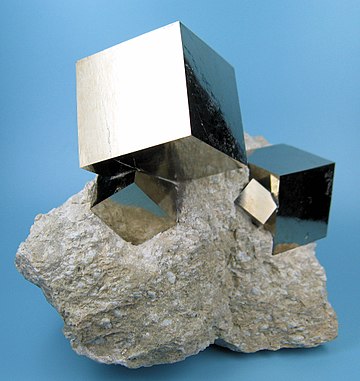
Iron Pyrite Crystals
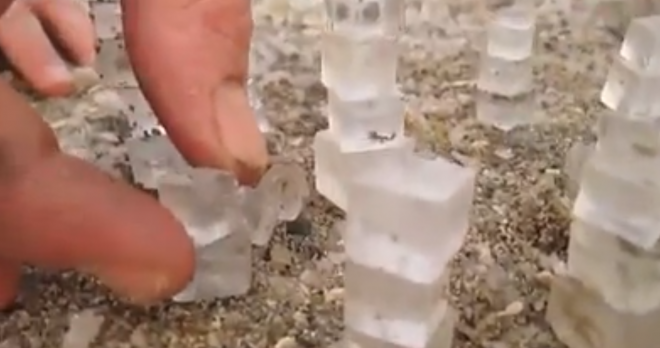
We have seen that 26 and 27 are connected to cubes. I have only been able to find two cubes in nature – salt and iron pyrite a.k.a. fool’s gold, wombat scat [7] notwithstanding. God’s people are called the salt of the earth. He chose salt, not fool’s gold. Salt is essential for life, fool’s gold is shiny and would no doubt be most people’s choice, it has commercial uses, but is not valuable like real gold. 


Natural Salt Crystals from the Dead Sea
Salt is readily available nowadays, but in times past, it was precious. “It is commonly believed that Roman soldiers were at certain times paid with salt. (They say the soldiers who did their job well were "worth their salt.") The word 'salary' derives from the Latin word salārium, possibly referring to money given to soldiers so they could buy salt.” Wikipedia "History of Salt" [8].


The cube area in back is the Holy of Holies [9].
The only cubes found in the Bible are the Holy of Holies of both the tabernacle and later the temple, and the city of New Jerusalem, described in Rev 21, which some interpret it as a cube, a square, or a pyramid. Nonetheless, all three are places where God dwells. More precisely, the tabernacle and temple are where God placed his name YHVH, ie 26.


1 Kings 9:3 The Lord (YHVH) said to him, “I have heard your prayer and your supplication, which you have made before Me; I have consecrated this house which you have built by putting My name there forever, and My eyes and My heart will be there perpetually.

God dwells in cubes, we are salt, and God dwells in us.

1 Corinthians 3:16 Do you not know that you are a temple of God and that the Spirit of God dwells in you?


What a beautiful picture, and all of this is pictured by my friend, number 26.


References

1. http://en.wikipedia.org/wiki/Gematria
2.http://www.hebrew4christians.com/Grammar/Unit_Eight/Hebrew_Gematria/hebrew_gematria.html
3. http://en.wikipedia.org/wiki/666_%28number%29
4. http://en.wikipedia.org/wiki/Hexakosioihexekontahexaphobia
5. http://www.normalesup.org/~baglio/maths/26number.pdf
6. http://amazingword.blogspot.com/2010/03/about-26-number-for-godliterally-both.html
7. http://io9.com/5872472/the-wombats-cubic-poop-is-one-of-natures-weirdest-superpowers
8. http://en.wikipedia.org/wiki/History_of_salt
9. https://servinghandskc.wordpress.com/2015/10/19/transporting-the-walls-of-the-tabernacle/

Saturday, September 13, 2014

Camping Foreshadows the Gospel


The story of the Exodus, ancient Israel leaving Egypt for the Promised Land, is rich with symbolism, perhaps more than any other event in the Bible.  Consider some parallels between Exodus and the life of a believer.  Egypt pictures slavery or bondage to sin.  Pharaoh pictures the evil one, the one we were enslaved to.  Crossing the Red Sea pictures deliverance from that bondage.  Although God Himself was right there, the people saw Moses as their deliverer.  Wandering for 40 years in the wilderness pictures a lifetime of testing, training, and proving. They didn't really wander in the wilderness – God led them the whole time by a pillar of fire or pillar of smoke. Crossing the Jordan to the Promised Land is a second deliverance, this time by Joshua.  The Promised Land was their reward. 

I doubt that the Israelites understood at the time that their journey, their entire lives, were symbolic of every believer's journey.  In short, the Exodus story pictures the gospel of the Kingdom of God. We must be delivered from slavery.  We must "wander" in this world being tried and tested.  We must be delivered from death into our Promised Land, the Kingdom of God.

Why camping?

Aside from the spiritual parallels which we will explore soon, there are physical benefits to camping. Outdoor recreation (camping) has been studied for decades. Quoting from the University of Minnesota Forestry Research Notes 1969 [1]:
Outdoor recreation gives rise to many kinds of social effects which are valued highly. One of these effects appears to be stronger family cohesiveness; i.e., enhancement of person-to-person intimacy binding a family group together. Family cohesiveness is important for several reasons: (1) it can promote effective socialization of children; (2) it can strengthen self-concepts of family members; and (3) it can improve the participant's satisfactions gained from association with other people.
Patrick C West writes about the group struggle, the shared recollection, and isolation in camping as factors that contribute to family cohesiveness (Outdoor Recreation and Family Cohesiveness) [2].  Those shared recollections may have been passed down through the generations to us (America and Britain are the descendants of ancient Israel*), and may explain why camping is so popular today.


But camping?

Ancient Israel was commanded to keep the Feast of Tabernacles to remember year-by-year that their ancestors dwelt in tents when they came out of Egypt, in other words, reminded that their forefathers camped. Israel dwelt in tents 40 years while they were in the wilderness between Egypt and the Promised Land. Actually they dwelt in tents longer than that, until Israel was settled in the land of Canaan, which took some time (When did Israel stop dwelling in tents?) [3]. A lot was happening while they were camping there. In addition to developing the cohesiveness mentioned above, and more than just remembering their humble beginnings, during the time in the wilderness the “old man” who left Egypt had to die, similar to what it says in Romans 6:6 "that our old man was crucified …that we would no longer be enslaved to sin".  And it was the new man, ie. the son, who entered Canaan.  

Not just any camping, but ancient Israel's camping in the wilderness foreshadowed the Gospel.  We still picture that today by keeping the Feast of Tabernacles.

Many teach that the Holy Days in Leviticus 23 picture the plan of salvation, which also parallels the journey from Egypt to Canaan.  The Feast of Tabernacles is the last festival of the seven and is often associated with the soon coming millennium, a kind of Promised Land, if you will. Tabernacles pictures many things, not just the millennium.

Why would God make a point to remind Israel they dwelt in booths when they came out of Egypt?  It doesn't look forward to a future fulfillment, but looks back to the Exodus. Lev 23:

42 You shall dwell in booths for seven days. All who are native Israelites shall dwell in booths, 43 that your generations may know that I made the children of Israel dwell in booths when I brought them out of the land of Egypt: I am the Lord your God.                   

The booths (Hebrew word sukkot) are also described in Lev 23:

40 And you shall take for yourselves on the first day the fruit of beautiful trees, branches of palm trees, the boughs of leafy trees, and willows of the brook

A little more info on sukkot from Wikipedia [4]:


The Hebrew word sukkot is the plural of sukkah, "booth or tabernacle", which is a walled structure covered with schach (plant material such as leafy tree overgrowth or palm leaves). 
The sukkah is intended as a reminiscence of the type of fragile dwellings in which the Israelites dwelt during their 40 years of travel in the desert after the Exodus from slavery in Egypt.

These sukkot only lasted the seven days of the Feast. The branches dried up and the sukkot fell apart.  Seven days pictures seven decades of a man's life.  But the same word sukkot is used in vs 43, not ohel, the normal word for tent, that is, it says Israel dwelt in sukkot when they left Egypt, but they lived in tents (ohel), not huts made from palm branches (sukkot).  Both tents and sukkot certainly are fragile dwellings.

Tents? Sukkot?

Traditionally, the book of Ecclesiastes is associated with the Feast of Tabernacles.  It is not a prophetic book about our future reward, but a reminder that life is fleeting – vanity of vanities, all is vanity (Eccl 1:1). In other words - Life is like a sukkot. Life is like a tent. Life is like a tent in the wilderness.

This is not a new idea, the apostle Paul wrote:

2Cor 5:1 For we know that if the earthly tent which is our house is torn down, we have a building from God, a house not made with hands, eternal in the heavens.

Some translations actually use the word tabernacle instead of tent.

We are the earthly tabernacles.

We are the tents.

Life is being played out in our bodies, our earthly tents, and the old man who came out of Egypt (slavery to sin) is dying while the new man is preparing to enter Canaan (enter the kingdom of God).  Is that not the good news of the Gospel?

---------------------------------------------------------------------------
*This is a big but important topic.  Many "Churches of God" have written extensively on it, see United Church of God, The United States and Britain in Bible Prophecy [5], or Christian Biblical Church of God, America and Britain--Their Biblical Origin and Prophetic Destiny [6].  For a more scholarly and thorough examination of the subject, I recommend Steve Collins, author of five books on the identity of Israel, Covering the Lost Tribes of Irsrael [7].

References

[1] http://conservancy.umn.edu/bitstream/57940/1/1969-201.pdf
[2] http://www.questia.com/read/1G1-206687213/outdoor-recreation-and-family-cohesiveness-a-research
[3] http://www.dabhand.org/MannersAndCustoms/tents.htm
[4] http://en.wikipedia.org/wiki/Sukkot
[5] http://www.ucg.org/booklet/united-states-and-britain-bible-prophecy/
[6] http://www.churchathome.org/pdf/America-and-Britain.pdf
[7] http://stevenmcollins.com/