Showing posts with label holy of holies. Show all posts

Tuesday, August 25, 2015

Into the Holy Of Holies


Cutaway view of the Tabernacle [1]
The Holy of Holies was a cube shaped room in the Tabernacle in the wilderness, and later in the Temples in Jerusalem. It was the inner room of the Holy Place. To get into it, one would have to enter the Tabernacle courtyard, pass the bronze altar, the bronze laver, enter the holy place, pass the showbread and lampstand and altar of incense, enter a special curtain on one side and walk to the other side to finally enter the Holy of Holies. It was a big deal. But only the High Priest (Cohen Ha Gadol) could make that trip, and he could only make it once a year, on the Day of Atonement (Yom Kippur).


A nation of millions of people, and only one person could enter the Most Holy Place once a year. This is the room that God Himself (YHVH) would speak from. Ex 25:22 "There I will meet with you; and from above the mercy seat, from between the two cherubim which are upon the ark of the testimony, I will speak to you about all that I will give you in commandment for the sons of Israel." His earthly throne, the mercy seat over the ark of the covenant, was the only furniture in the room. (By the way, the word for ark used here is Aron, not the same word as Noah's ark, Tibah.) And the High Priest couldn't just stroll in there on Yom Kippur, he had very detailed instructions on clothing, bathing, sacrifices, and other rituals he had to perform just so in order to enter.

It suggests how far from God we are, how difficult it is to approach Him with our own righteousness. Indeed, Israel couldn't even approach Him directly, they needed a High Priest to intervene for them. Is there no other way in? How do we enter that curtain?

There Is Another Way In 


2D Diagram Of The Tabernacle [2]

The Holy Place is a tent within a tent, covered on all sides. But look at what is next to the Holy of Holies, right outside the curtain - the Table of Incense.

The smoke from the incense makes its way past the veil. The formula for this incense is given right in the Bible.

Ex 30:And the LORD said unto Moses, Take unto thee sweet spices, stacte, and onycha, and galbanum; these sweet spices with pure frankincense: of each shall there be a like weight
These ingredients, stacte [3], onycha [4], galbanum [5], and frankincense [6] make "sweet incense" to be burned twice daily in the Tabernacle. The High Priest was responsible for making sure this happened every day.
Ex 30:7 And Aaron shall burn thereon sweet incense every morning: when he dresseth the lamps, he shall burn incense upon it.
8 And when Aaron lighteth the lamps at even, he shall burn incense upon it, a perpetual incense before the LORD throughout your generations.
Incense is an aroma that God enjoys and wants every day. It bypasses the veil, and the High Priest, and drifts into the Holy of Holies.

Why would anyone care?

Because incense is prayer -- Our prayers. 


Our prayers go straight to God's throne. Directly. It is our way in!
Ps 141:2 May my prayer be counted as incense before You; The lifting up of my hands as the evening offering
Rev 8:4 And the smoke of the incense, with the prayers of the saints, went up before God out of the angel's hand
In other words, "The fragrance of our words wafts through the throne room" John Paul Jackson [7].

Our Prayers Are Like Incense


We have access to the Holy of Holies in heaven because of Christ's death on the cross. This was pictured in a very real sense when He died.
Mk 15:37 And Jesus uttered a loud cry, and breathed His last.
Mk 15:38 And the veil of the temple was torn in two from top to bottom.
The Ark visible through the torn veil [8]
Looking out through the torn veil [9]


Heb 10:19 Therefore, brethren, since we have confidence to enter the holy place by the blood of Jesus
But we aren't in heaven, we are here. Christ is the High Priest, not any of us. Our way into the Holy of Holies is by our prayers like incense coming before God the Father as a sweet aroma. That's how we enter.

Effective Prayers


Well, effective prayer is a whole topic unto itself. But from the point of view of the Tabernacle of Moses, consider that the incense was a specific formula. And the one who offers the incense must first be clean. And the incense must be offered daily. In terms of our everyday life, here is what Maria Merola [10] said, "Praying the effectual fervent prayer is a lifestyle that is lived out daily...he is after a sincere heart of worship and humility." That's a good place to start.

I never thought of my prayers as being sweet incense, and many days, they aren't sweet incense, more like whining in the Holy Place, but our heavenly Father sees them as sweet incense. Lighting the incense twice a day? Still working on it.

References

1. http://www.israel-a-history-of.com/tabernacle-of-moses.html
2. https://www.jesuswalk.com/spirit/05_spirit_within.htm
3. https://en.wikipedia.org/wiki/Stacte
4. https://en.wikipedia.org/wiki/Onycha
5. https://en.wikipedia.org/wiki/Galbanum
6. https://en.wikipedia.org/wiki/Frankincense
7. http://www.streamsministries.com/resources/discipleship/prayers-like-incense
8. http://doubleportioninheritance.blogspot.com/2011/01/effectual-fervent-prayer-of-righteous.html
9. https://withmeagrepowers.wordpress.com/tag/gospel-of-matthew/
10. http://doubleportioninheritance.blogspot.com/2011/01/effectual-fervent-prayer-of-righteous.html

Thursday, January 1, 2015

26


[Reconstruction of a speech I gave to our church men's club in 2012. My hard drive crashed, and I didn’t save a paper copy of the text. I also made minor changes to take advantage of the printed word.]

Numbers are my friends. People make good friends too, but numbers you can count on…


Let me introduce you to my friend 26, a very interesting number. I picked 26 because God’s name is associated with it. His name is not associated with more popular numbers like seven or 12, but 26. Why 26? Proverbs 25:2 says It is the glory of God to conceal a thing: but the honour of kings is to search out a matter.  Can we search out this matter?


First, let’s see why God’s name YHVH (יהוה) is associated with 26. In ancient Hebrew there are no separate symbols for numbers, they reused the letters. So every word in the Old Testament takes on a numerical meaning. It’s a simple substitution code - here are the first 10 letters.

א ב ג ד ה ו ז ח ט י
1 2 3 4 5 6 7 8 9 10


 Mapping letters to numbers is known as Gematria, the full table of letter/number mappings can be seen at wikipedia [1] or hebrew4christians.com [2]. By the way, this also works in English for the word “God” – again a simple substitution A = 1, B = 2, C = 3, D = 4, … G = 7, …O = 15 makes GOD = 26. I won’t defend Gematria too hard, it has its uses and limits. For example, there are alternate letter/number mappings, are any of these mappings “sacred”? You can’t use Gematria to establish doctrine, that must come from the plain text, but I think it’s possible to unconver hidden connections in Scripture. Consider this – “Six hundred sixty-six is called the "number of the beast" in (most manuscripts of) chapter 13 of the Book of Revelation, of the New Testament, and thus also in popular culture.” Wikipedia 666 [3]. So there is at least one example of Gematria in the Bible. Incidentally, I learned that the fear of 666 is called hexakosioihexekontahexaphobia [4].

Anyway YHVH = 26 is well known. Let’s see where it leads. Is there anything special about 26? There is no number that’s not interesting, and there is a simple proof. Let N be the first uninteresting number. Isn’t that interesting? 


Here is an interesting mathematical fact about 26.


26 is the only integer that is one greater than a square (25 = 52) and one less than a cube (27 = 33). Full proof (not for the feint of heart) at www.normalesup.org [5].


Big deal. All that shows is that 26 actually is an interesting number. Some want to say that by being between a square and a cube, 26 is a bridge between physical and spiritual, I think that’s a stretch. But I do believe it shows God’s humility because 26 is not an obvious choice like 7. It invites us to dig a little deeper to get to know Him.


While everything in nature reflects God in some way, in His word He reveals Himself and His plan through 26. Consider these examples.


·        Gen 1:26 - Then God said, "Let Us make man in Our image, according to Our likeness; …”
·        Ps 136 is 26 verses, each verse has the phrase “for He is good, and His mercy endures forever”. “ki tov ki l’olam kasdo”
·        The Greek Strongs number G26 is Agape which means Love, an attribute of God
·        According to Jewish chronology, God gave the Torah to Moses in the 26th generation since Adam
·        You can read many more interesting facts about 26 at amazingword.blogspot.com [6]


Let’s consider some more math, (maths to the Brits). A 3 x 3 x 3 cube, think
Rubik’s cube, has 26 visible cubes, and one invisible cube in the center. We may not be able to see it, but we know where it is and how big it is. The invisible is known by the visible. Rom 1:20 “For since the creation of the world His invisible attributes, His eternal power and divine nature, have been clearly seen, being understood through what has been made, so that they are without excuse.”


But wait, there’s more.


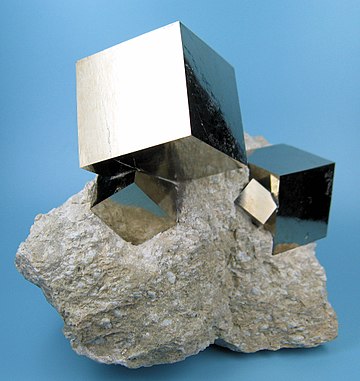
Iron Pyrite Crystals
We have seen that 26 and 27 are connected to cubes. I have only been able to find two cubes in nature – salt and iron pyrite a.k.a. fool’s gold, wombat scat [7] notwithstanding. God’s people are called the salt of the earth. He chose salt, not fool’s gold. Salt is essential for life, fool’s gold is shiny and would no doubt be most people’s choice, it has commercial uses, but is not valuable like real gold. 


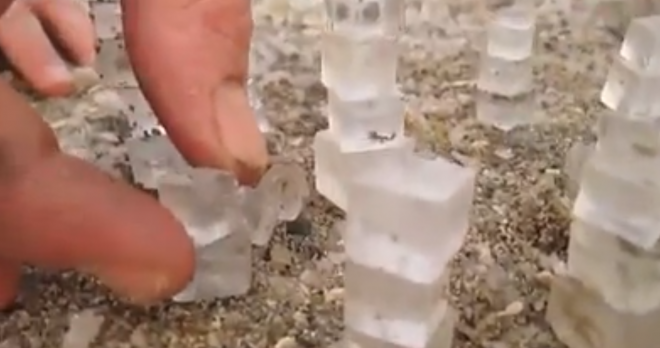
Natural Salt Crystals from the Dead Sea
Salt is readily available nowadays, but in times past, it was precious. “It is commonly believed that Roman soldiers were at certain times paid with salt. (They say the soldiers who did their job well were "worth their salt.") The word 'salary' derives from the Latin word salārium, possibly referring to money given to soldiers so they could buy salt.” Wikipedia "History of Salt" [8].


The cube area in back is the Holy of Holies [9].
The only cubes found in the Bible are the Holy of Holies of both the tabernacle and later the temple, and the city of New Jerusalem, described in Rev 21, which some interpret it as a cube, a square, or a pyramid. Nonetheless, all three are places where God dwells. More precisely, the tabernacle and temple are where God placed his name YHVH, ie 26.


1 Kings 9:3 The Lord (YHVH) said to him, “I have heard your prayer and your supplication, which you have made before Me; I have consecrated this house which you have built by putting My name there forever, and My eyes and My heart will be there perpetually.

God dwells in cubes, we are salt, and God dwells in us.

1 Corinthians 3:16 Do you not know that you are a temple of God and that the Spirit of God dwells in you?


What a beautiful picture, and all of this is pictured by my friend, number 26.


References

1. http://en.wikipedia.org/wiki/Gematria
2.http://www.hebrew4christians.com/Grammar/Unit_Eight/Hebrew_Gematria/hebrew_gematria.html
3. http://en.wikipedia.org/wiki/666_%28number%29
4. http://en.wikipedia.org/wiki/Hexakosioihexekontahexaphobia
5. http://www.normalesup.org/~baglio/maths/26number.pdf
6. http://amazingword.blogspot.com/2010/03/about-26-number-for-godliterally-both.html
7. http://io9.com/5872472/the-wombats-cubic-poop-is-one-of-natures-weirdest-superpowers
8. http://en.wikipedia.org/wiki/History_of_salt
9. https://servinghandskc.wordpress.com/2015/10/19/transporting-the-walls-of-the-tabernacle/