In a remarkable fashion,
the Bible records a violation of nine of the Ten Commandments in
turn, after which ancient Israel is taken into captivity. It shows
God gave the nation nine chances, they blew it nine times, and ended
up in exile. Of course the Bible records many instances of
commandment breaking, but these nine have special significance. They
have national consequences. This is the basis of the book The
Nine Commandments [1] by
David Noel Freedman. Critics don't all agree with Freedman, I'll first present Freedman's idea, then I'll give some space for the critics - you can decide whether it has merit or not.
People don't agree on
the numbering of the Ten. I will give the short form of each as we
come to it. I like the King James for the Commandments because it uses Thou which is second person singular - 10 Commandments [2]
And click the "Follow" button so you don't miss an article.
Why National Consequences?
 |
Twelve Tribes of
Ancient Israel |
God spoke the TEN
commandments to the people from Mount Sinai - Ex 20. The Ten
Commandments are more than a moral code to rule a people, they are a
covenant between God and ancient Israel. "And he wrote on the
tablets the words of the covenant, the Ten
Commandments." - Ex 34:28. The covenant
includes text from chapters 20 - 24 of Exodus, where chapter 20 lists
the Ten Commandments, the only part spoken by God Himself from Mount
Sinai. This was the first time God made a covenant with a nation.
Before this, he had made covenants with individuals, like Adam and
Eve, Noah, Abraham, Isaac, and Jacob. But now He made a nation of
Jacob's descendants, and He made a covenant with them. The children
of Israel had to obey the voice of God, in return, God promised them
this:
Ex 19:5 Now if you obey
me fully and keep my covenant, then out of all nations you will be my
treasured possession. Although the whole earth is mine, 6 you will be
for me a kingdom of priests and a holy nation.'
Israel agreed.
Ex 24:3 Then Moses came
and reported to the people all the words of the LORD and all the
ordinances; and all the people answered with one voice and said, “All
the words which the LORD has spoken we will do!”
Commandments 1 And 2
Thou shalt have
no other gods before me.
Thou shalt not make any graven image or
bow down to them.
After the
people promised to obey the Ten Commandments, Moses went up the
mountain to receive the two tablets from God. He was gone for 40
days, and when he came down, the people had managed to violate
Commandments 1 and 2 in the golden calf incident. Here is how God
describes their actions to Moses:
Exodus 32:8 How quickly
they have turned aside from the way that I
commanded them!
They have made
for themselves
a molten calf and have bowed
down to it.
They have sacrificed to it and said, 'These,
O Israel, are your gods,
who brought you up out of the land of Egypt.'"
Note how this language
parallels the commandment.
Exodus 20:3 AFV You shall
have no
other gods before Me.
4 You shall not make for yourselves any graven image, ... 5 You shall not bow yourself down to them, nor serve them;
The consequence for this was severe. God threatened
to wipe them all out and start over with Moses, though that was
probably a test for Moses. A very real consequence was the death of
3000 men.
Exo 32:28 And the
children of Levi did according to the word of Moses: and there fell
of the people that day about three thousand men.
Quoting
Freedman
With the violation of
commandments one and two, Israel has begun its downward trek, a trek
that will take them through each commandment, one by one, book by
book, until all are broken, resulting in their exile from the
Promised Land. p 45
Book two – Commandments
one and two.
Commandment Three
Thou shalt not
take the name of the LORD thy God in vain.
Leviticus is known for
laws, not for narrative. But there is one story in Leviticus that
seems to be out of place. It is the episode of blasphemy. The first
half of chapter 24 talks about items in the Tabernacle, and then the
text jumps to a story of two men fighting where one of them curses
God's name (literally made light of THE NAME), then chapter 24
continues with more laws.
The offender, who is not
even named in the story, is jailed, brought to Moses, who appeals to
God, who sentences him to death by stoning by the congregation. This
sets a legal precedent for Israel. What began as an altercation
between two men became the business of the whole nation. The whole
congregation participated in the stoning to purge Israel of its
guilt. It also shows that the Law applies to the native Israelite and
the non-native.
Book three - Commandment
three.
Commandment Four
Remember the
Sabbath Day to keep it Holy.
 |
| Gathering sticks |
We
saw that the story of breaking of Commandment three seems out of place in
Leviticus. We see a similar story that seems out of place in Numbers.
While Numbers has more narrative passages than Leviticus, note
Numbers chapter 15 - various laws are given concerning Sacrifices,
Unintentional Sins, and Tassels on Garments. But in the middle of
these laws is a short story of a man who violated the Sabbath by
picking up sticks (vs 32-36). Our attention is drawn to it by being
placed there and by the parallels with the Leviticus story - the
offender is not named, he is jailed, brought to Moses, and God
sentenced him to death by stoning. And like the blasphemy story, the
punishment was not specified beforehand. The people found him
gathering sticks (vs 32), so it was no longer just about him alone,
it became the business of the whole nation.
Book four -
Commandment four.
Commandment Five
Honor
thy father and thy mother.
In Deuteronomy
21, Moses is giving various laws to the people. Verses 18-21
describes what to do with a “stubborn and rebellious son”. The
passage reads like a legal proceeding.
- The guilty
party is seized by witnesses
- The guilty
party is brought to a judging body
- The crime
is communicated
- The guilty
party is stoned
- Evil is
purged
Sound familiar?
It's Leviticus 24 and Numbers 15 all over again. “Nowhere
else in Deuteronomy do we find all of these elements together.”
[1] Here
are some things to note. Both parents bring their son to the elders
of the city for judgment. They must testify that he is stubborn and
rebellious despite discipline. And that led to unacceptable behavior,
namely disobedience, gluttony, and drunkenness.
This passage
might be included because like blasphemy and Sabbath breaking, the
penalty for not honoring parents was never given before. But the
thing is, there is no case recorded anywhere that this process
was ever done. I don't think it means there was never a son in
ancient Israel that was stubborn and rebellious. It means that no
parents could bring themselves to do it. I never had kids, but I
can't imagine doing it. Now bringing someone else's kid to the city
elders...
It might be
that if stubborn and rebellious sons were brought to justice by
their own parents,
things would have turned out better for Israel, that is the people
would hear and fear. It is remarkable that Jesus became sin for us,
and God the Father was willing to put Him to death.
Book
five - Commandment five.
Transition
This is the end of the Torah, the five
books of Moses. Now we move into the section known as the Prophets.
In the Hebrew Bible, the first four books in this section are Joshua,
Judges, Samuel, and Kings. Note that Samuel and Kings are not split
in two. And note that Ruth is not here. The Torah plus these four
books is sometimes called the Primary History (of Israel).
The question is whether the pattern of
commandment violation book by book continues after the Torah. The
answer is yes and no. We still see one violation per book, but the
order is changed a little. From the pattern so far, we would expect
to see a murder in book six (Joshua), but in fact stealing is the
next commandment violated. Freedman argues that if we follow the
order of Jeremiah 7, the book/commandment correspondence stays
aligned.
Jer 7:9 Will you steal, murder, commit adultery, swear falsely, offer sacrifices to Baal, and follow other gods that you have not known,
One way or another, we will get back in sync before we're done.
Commandment Eight
Thou
shalt not steal
After
40 years in the wilderness, Israel begins to conquer the Promised
Land, beginning with a memorable victory over Jericho (Josh 6), which
gave the Israelites great confidence that God will grant them
continuous victories. But the next time out (Josh 7), they got
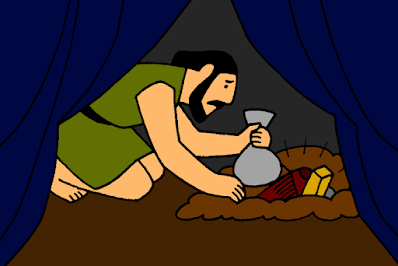
defeated, so Joshua asks God why. The reason is because a man named
Achan stole some gold and silver that was forbidden. God reserved the
gold and silver spoils from Jericho for the Tabernacle. Ultimately,
Achan was found out, and although he confessed (Josh 7:20-21), he was
sentenced to death. It was so serious that his family was put to
death as well. Normally, the penalty for stealing was to repay what
was stolen, in some cases to pay five times over. This is the only
instance of the death penalty for stealing [1]. But this was
stealing from God, and it affected the whole nation. It is also the
only case of anyone stealing from the forbidden spoils [1]. How can
we know it is THE Commandment violation for the book of Joshua?
Achan's crime is the only sin by an Israelite in the book [1].
We
see that the Lord held the whole camp of Israel accountable for the
act of one man and withheld His blessing until the matter was
corrected - Sin of Achan [3].
Josh
6:18 GNT But you are not to take anything that is to be destroyed; if
you do, you will bring trouble and destruction on the Israelite camp. 19
Everything made of silver, gold, bronze, or iron is set apart for the
LORD. It is to be put in the LORD's treasury.
Josh
7:1 ASV But the children of Israel committed a trespass in the
devoted thing; for
Achan, the son of Carmi, the son of Zabdi, the son of Zerah, of the
tribe of Judah, took of the devoted thing: and the anger of Jehovah
was kindled against the children of Israel.
Listen
to the language used to describe the incident.
Josh
7:11 HOLMAN Israel has sinned. They have violated My covenant that I
appointed for them. They have taken some of what was set apart. They
have stolen, deceived, and put the things with their own belongings.
Jos
7:21 When I saw among the spoils a goodly Babylonish garment, and two
hundred shekels of silver, and a wedge of gold of fifty shekels
weight, then I COVETED them, and took them; and, behold, they are hid
in the earth in the midst of my tent, and the silver under it.
Book
six - Commandment eight.
Commandment Six
Thou
shalt not murder.
 |
| Murdered Concubine |
I
find the last three chapters of Judges (19-21) difficult to read. The
story starts out with parallels to Lot in Sodom, and like Sodom ends
VERY badly. The concubine of a Levite is raped to death in Gibeah, a
town of the tribe of Benjamin. The Levite sends pieces of her body to
every tribe, and they respond in force against Benjamin. When
Benjamin refuses to turn over the perpetrators, civil war breaks out.
Israel kills nearly all the men of Benjamin.
If
you read this in the KJV, you won't see that this is a case of
murder.
Judg
20:4 KJV And
the Levite, the husband of the woman that was slain
In
nearly all other translations, it reads “the
woman who was murdered'.
It does not say “the woman who died”, or “the woman who was
killed”, but “the woman who was murdered”. In fact, this is the
first story since Sinai to use the Hebrew word ratsach as
found in the Commandment. Ratsach
is
a legal term like the English homicide.
The
community is required to see that the commands are enforced and
violations are punished. If the individual is not held accountable
for his or her crime, the entire community becomes guilty - [1 p117].
Book
seven - Commandment six.
Commandment Seven
Thou
shalt not commit adultery.
There
is only one case of adultery in the Hebrew Bible where the crime, the
participants, and the events surrounding it are all made explicit. It
is also one of the most famous cases of adultery in all literature - [1 p130].
 |
Nathan Confronts David
|
This
is referring to King David and Bathsheba. Since it is so well known,
I won't need to rehearse any of it here, just a couple remarks. When
confronted by Nathan the Prophet, David confesses like Achan. But
unlike Achan, David (and Bathsheba) are not put to death, which is
the penalty in Lev 20:10. He does not escape justice though. David's
crime of adultery is the turning point in his reign.
2
Sam 12:10 Now then, the sword shall never leave your house, because
you have despised Me and have taken the wife of Uriah the Hittite to
be your wife.’
11
This is what the LORD says: ‘Behold, I am going to raise up evil
against you from your own household; I
will even take your wives before your eyes and give them
to
your companion, and he will sleep with your wives in broad daylight.
It may be a coincidence, but now
that Israel is a monarchy, these last two violations are done by
royalty. One near the beginning of the kingdom, one near the end.
Book eight - Commandment seven.
Commandment Nine
Thou shalt not bear false witness
against thy neighbor.
With Commandment Nine, we get back
in sync.
Not bear false witness. This is
carefully worded because it is a legal term. The Bible condemns lying
in many passages, but this commandment is not a simple injunction
against lying in general. It is specific. We might say “Thou shalt
not perjure against thy neighbor”.
All
false witnessing is a lie, but not all lies are false witnesses Hermeneutics(Lying Tongue) [4]
False witnessing attempts to
pervert the course of justice.
Bearing
false witness, on the other hand, is a lie with intent to inflict
damage on another innocent party Frontiersman(False Witness) [5].
In fact, according to Jewish
teaching, lying is permitted to deceive the enemy or to save life - Wikipedia(Jewish view on lying) [6]
 |
| Ahab Asks Naboth |
The violation of the ninth
commandment is also a well known story. It is the dispute between
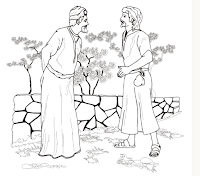
King Ahab and Naboth (1 K 21). Ahab covets Naboth's vineyard, but
Naboth won't sell. Jezebel induces two false witnesses to testify
against Naboth. But it wasn't any old charge against Naboth, they
testified that he spoke against God and king, which carried a twofold
penalty. Naboth was put to death with his family, and his property
reverted to the monarchy, so Ahab got the vineyard he desired. BTW,
Ahab and Naboth were actual neighbors.
It didn't end well for Ahab or
Jezebel. Some of Ahab's punishment was postponed to his sons days
because he humbled himself, but he met his end three years later in 1
K 22. Jezebel met her end in 2 K 9:30-37.
Book nine - Commandment nine.
The Tenth Commandment
Israel has broken the covenant
commandment by commandment in order. The end result will be exile,
about 100 years after Ahab, as told in the Primary history.
Why is there no tale devoted to
the Tenth Commandment? One reason there is no story devoted to
coveting is that it has no observable behavior, but it is evident in
the violations of commandments six through nine that coveting was the
motivation.
Achan coveted the gold and
silver.
The Benjamites coveted (lusted
after) sex.
David coveted (lusted after)
Bathsheba.
Ahab coveted Naboth's vineyard.
Intent
is important in modern justice and was important in ancient Israel,
but only after
a crime is committed. Attitude cannot be punished in the absence of a
criminal action, Thought Police notwithstanding.
It's
more than exile for Israel. By giving example violations of nine out
of ten commandments, the Bible is drawing attention to the one left
out. Sin starts in the mind, that's where the battle is. If you would
not sin, don't covet. And not just commandments six through nine,
consider Col 3.
Col
3:5 Put
to death therefore what is earthly in you: sexual immorality,
impurity, passion, evil desire, and covetousness,
which is idolatry.
I would have never figured that
out on my own.
- Finally,
I wonder if these violations are playing out in modern America. Have
we not seen public examples of bearing false witness, stealing,
adultery, and murder? God exiled Israel for breaking all the
commandments of His covenant. Will He do any differently with
America?
But, Is It So?
Let's turn our attention to Freedman's critics. They raise several objections to the main thesis that nine Commandments were violated in nine books, then God exiled Israel.
- What about Genesis? Commandment One (no other gods before Me) is violated in the Garden of Eden, but Freedman doesn't start counting till Exodus when Commandments One and Two are violated. Why not start counting in Genesis? The best explanation is that the count couldn't start till the covenant with the whole nation of Israel, which happened in Exodus 20.
"Special pleading", as is the placing of the first two violations in Exodus, with none in Genesis (none that he counts anyway; in reality there are many in Genesis). -
Amazon review [7]
- It really breaks the pattern that the Commandment violations don't follow the order in Exodus 20 or Deuteronomy 5. Dennis T. Olson sums it up this way.
Why would the master editor arrange these narratives in an alternative order of the commandments known only from an obscure reference in Jeremiah 7 (theft, murder, adultery)? - - 2000 Year Secret [8]
- I pointed out above that there isn't an actual violation of Commandment 5 (Honor your parents). Every other violation is listed, and some quite heinous, so it's surprising this one is left out. Again it ruins the pattern.
- Is it true that "bearing false witness" is the last straw, after which exile is a certainty? First of all, it took over 100 years to go from Ahab and Naboth to exile, and over 100 more years till Judah was taken captive - that doesn't seem like a last straw. Second, if Ahab (northern kingdom) violated the ninth Commandment, why did Judah (southern kingdom) go into exile? Third, the prophets are clear about why God exiled Israel, it was due to idolatry. 2 Kings 17 talks about commandment breaking in general, but really focuses on idolatry as the core reason for exile.
2K 17:18 AFV So the LORD was very angry with Israel and removed them out of His sight; not one was left, only the tribe of Judah by itself.
- In some of the example violations, other Commandments were broken, arguably more serious ones. For example, in the case of David's adultery, Nathan the prophet rebukes him first for killing Uriah.
2Sam 12:9 AFV Why have you despised the word of the LORD to do evil in His sight? You have stricken Uriah the Hittite with the sword and have taken his wife to be your wife, and have killed him with the sword of the children of Ammon.
And in the case of Ahab and Naboth, bearing false witness seems a lesser crime than killing Naboth, stealing his land, or the idolatry of Ahab and Jezebel.
1K 16:31 And as if it had been a light thing for him to walk in the sins of Jeroboam the son of Nebat, he took for his wife Jezebel the daughter of Ethbaal king of the Sidonians, and went and served Baal and bowed down to him.
- And one critic remarked that no one noticed this pattern for over 2000 years - [8]. To be fair, one point of scholarship is to find new things, even in text that is thousands of years old.
However, even Freedman's critics admit the idea is intriguing, and the book is a worthwhile read regardless. I encourage you to read the book, and make up your own mind.
References
1. https://www.amazon.com/Nine-Commandments-Uncovering-Pattern-Punishment/dp/0385499876
2. https://jlfreeman-1.blogspot.com/2015/12/ten-little-known-facts-about-ten.html
3. https://bible.org/seriespage/6-defeat-ai-and-sin-achan-joshua-71-26
4. https://hermeneutics.stackexchange.com/questions/11651/whats-the-difference-between-a-lying-tongue-and-a-false-witness-in-proverbs
5. https://www.frontiersman.com/faith/much-more-to-bearing-false-witness-than-lying/article_0ba5fb7d-18ac-5ac2-ac43-e59048d9d265.html
6. https://en.wikipedia.org/wiki/Jewish_views_on_lying
7. https://www.amazon.com/Nine-Commandments-Uncovering-Pattern-Punishment/dp/0385499876
8. https://www.thefreelibrary.com/A+2%2C000-Year+Secret+Revealed%3F+The+value+of+Freedman%27s+book+is+less+in...-a071767581
Commandments
Thou shalt have no other gods before me.
Thou shalt not make any graven image or bow down to them.
Thou shalt not take the name of the LORD thy God in vain.
Remember the Sabbath Day to keep it Holy.
Honour thy father and thy mother.
Thou shalt not kill.
Thou shalt not commit adultery.
Thou shalt not steal.
Thou shalt not bear false witness against thy neighbour.
Thou shalt not covet any thing that is thy neighbours.
Scriptures
Commandments
1 & 2 - Exodus 32
Commandment
3 - Lev 24:10-17
Commandment
4 - Numbers 15:32-36
Commandment
5 - Deuteronomy 21:18-21
Commandment
6 - Judges 19-21
Commandment
7 - 2 Samuel 11-12
Commandment
8 - Josh 7
Commandment
9 - 1 Kings 21


