The Jewish tradition is to read the book of Ruth at Pentecost. They give many good reasons for this, here are two, read more at Wiki(Shavuot) [1].

- The events of the book of Ruth take place during the barley and wheat harvest season, that is, basically covering the seven week period from Wave Sheaf Day to Pentecost (Firstfruits to Shavuot).
Rth 1:22 ... and they came to Bethlehem in the beginning of barley harvest.
Rth 2:23 So she stayed close by the maids of Boaz in order to glean until the end of the barley harvest and the wheat harvest. And she lived with her mother-in-law.
- Ruth was recognized for her kindness in caring for her mother in law Naomi. Boaz noticed her for her kindness, and was eager to redeem her. Ruth wasn't out to save the world, she sought to look after ONE person, Naomi; and her story became part of God's word, and she became the mother of kings. She shaped history by her kindness.
Rth 3:11 Now, my daughter, do not fear. I will do for you whatever you ask, for all my people in the city know that you are a woman of excellence (virtue).
Christians have more reasons to study the book of Ruth. The events described are filled with prophetic meaning, some fulfilled, some still future. Consider that Naomi pictures Israel, Ruth pictures the church, and Boaz the kinsman redeemer pictures Jesus Christ.
If you like this (or not), check out my other articles at the
Between The Ears BLOG INDEX, with titles and summaries.
Between The Ears BLOG INDEX, with titles and summaries.
To understand the story, we will have to refer to a few laws found in the books of Moses concerning gleaning, Levirate marriage, and redemption of land. I will summarize the book, comment on some interesting tidbits, and focus on a few verses of interest. I assume you are familiar with the story, if not, note that the Book of Ruth is only four chapters, 85 verses in all. You can read it in a few minutes.
The Story Of Naomi, Ruth, and Boaz
A Jewish man named Elimelech falls on hard times (a famine), then takes his wife Naomi and his two sons Mahlon and Chilion to the land of Moab. Mahlon marries Ruth, (which we don't learn until Ruth chapter 4, chapter 1 only tells us that the sons married Ruth and Orpah). Elimelech and his sons die, so Naomi heads back to Israel. She tells her daughters in law to return to their parents, but Ruth clings to Naomi.
Elimelech - My God Is King
Naomi - Pleasant, Desire
Mahlon - Sickly
Chilion - Failing, Wasting
Ruth - Friend, Vision
Orpah - Neck, Drip, Cloud
Gleaning

So how do two widows support themselves? By gleaning the fields during harvest. Gleaning was ancient Israel's welfare system. The poor, especially widows and orphans and strangers or foreigners were allowed to do this. It wasn't a handout, they had to work in the fields.
Lev 23:22 When you reap the harvest of your land, moreover, you shall not reap to the very corners of your field nor gather the gleaning of your harvest; you are to leave them for the needy and the alien. I am the LORD your God
Did you notice that this verse on gleaning is in the middle of the chapter that describes all the Holy Days? And it falls immediately after describing Shavuot. One verse seemingly out of place in the listing of the Holy Days, as if to draw one's attention to the connection between Pentecost and Ruth.
 |
| Salador Dali "Familia Ruth Moabitidis" |
Deu 25:5 When brothers live together and one of them dies and has no son, the wife of the deceased shall not be married outside the family to a strange man. Her husband's brother shall go in to her and take her to himself as wife and perform the duty of a husband's brother to her. 6 It shall be that the firstborn whom she bears shall assume the name of his dead brother, so that his name will not be blotted out from Israel.
In short, the widow of a man who dies without a son can marry his brother to produce an heir.
Lev 25:23 The land, moreover, shall not be sold permanently, for the land is Mine; for you are but aliens and sojourners with Me. 24 Thus for every piece of your property, you are to provide for the redemption of the land. 25 'If a fellow countryman of yours becomes so poor he has to sell part of his property, then his nearest kinsman is to come and buy back what his relative has sold.
The problem is that Boaz is not a brother to Mahlon and is not obligated by Dt 25 to marry Ruth, and redeeming land as described in Lev 25 doesn't require marrying the kinsman's widow - Israel My Glory [2]. However, both Naomi and Boaz do refer to Levirate marriage to raise up a son for the deceased. And everyone in the story had the expectation that marrying Ruth was part of redeeming the land. So the word "brother" in Dt 25 may have been expanded to include nearest kinsman.
The Threshing Floor Scene
So with the law of the Kinsman Redeemer in mind, read the Threshing Floor Scene.
Rth 3:7 When Boaz had eaten and drunk and his heart was merry, he went to lie down at the end of the heap of grain; and she came secretly, and uncovered his feet and lay down. 8 It happened in the middle of the night that the man was startled and bent forward; and behold, a woman was lying at his feet. 9 He said, "Who are you?" And she answered, "I am Ruth your maid. So spread your covering over your maid, for you are a close relative (near kinsman)." 10 Then he said, "May you be blessed of the LORD, my daughter. You have shown your last kindness to be better than the first by not going after young men, whether poor or rich. 11 Now, my daughter, do not fear. I will do for you whatever you ask, for all my people in the city know that you are a woman of excellence. 12 Now it is true I am a close relative (near kinsman); however, there is a relative closer (nearer kinsman ) than I.

The Redemption
Boaz seemed eager to settle the matter - he gave Ruth six measures of barley for Naomi. Six indicates that Ruth's labor is done, and Boaz won't rest till the matter is concluded - SuperiorWord [4].
Rth 4:5 Then Boaz said, "On the day you buy the field from the hand of Naomi, you must also acquire Ruth the Moabitess, the widow of the deceased, in order to raise up the name of the deceased on his inheritance." 6 The closest relative (nearer kinsman) said, "I cannot redeem it for myself, because I would jeopardize my own inheritance. Redeem it for yourself; you may have my right of redemption, for I cannot redeem it."Rth 4:8 So the closest relative (nearer kinsman) said to Boaz, "Buy it for yourself." And he removed his sandal. 9 Then Boaz said to the elders and all the people, "You are witnesses today that I have bought from the hand of Naomi all that belonged to Elimelech and all that belonged to Chilion and Mahlon. 10 Moreover, I have acquired (purchased) Ruth the Moabitess, the widow of Mahlon, to be my wife in order to raise up the name of the deceased on his inheritance, so that the name of the deceased will not be cut off from his brothers or from the court of his birth place; you are witnesses today.
Boaz, The Kinsman Redeemer

- He must be near of kin.
Hebrews 2:17 Therefore, He had to be made like His brethren in all things, so that He might become a merciful and faithful high priest in things pertaining to God, to make propitiation for the sins of the people.
- He must be able to redeem, ie not need redemption himself.
Being the Son of God and living a sinless life qualified Jesus to redeem.
Rev_5:9 And they sung a new song, saying, Thou art worthy to take the book, and to open the seals thereof: for thou wast slain, and hast redeemed us to God by thy blood out of every kindred, and tongue, and people, and nation;
- He must be willing to redeem.
John 10: 17 For this reason the Father loves Me, because I lay down My life so that I may take it again. 18 No one has taken it away from Me, but I lay it down on My own initiative.
- Redemption was completed when the price was completely paid.
He paid the penalty of our sins with His own blood. Note that some authors have a different fourth requirement, "He must accept all the obligations of Redeemer" - Chuck Missler [6], referring to the nearer kinsman being unwilling to take Ruth with the land.
Ruth, the Moabitess
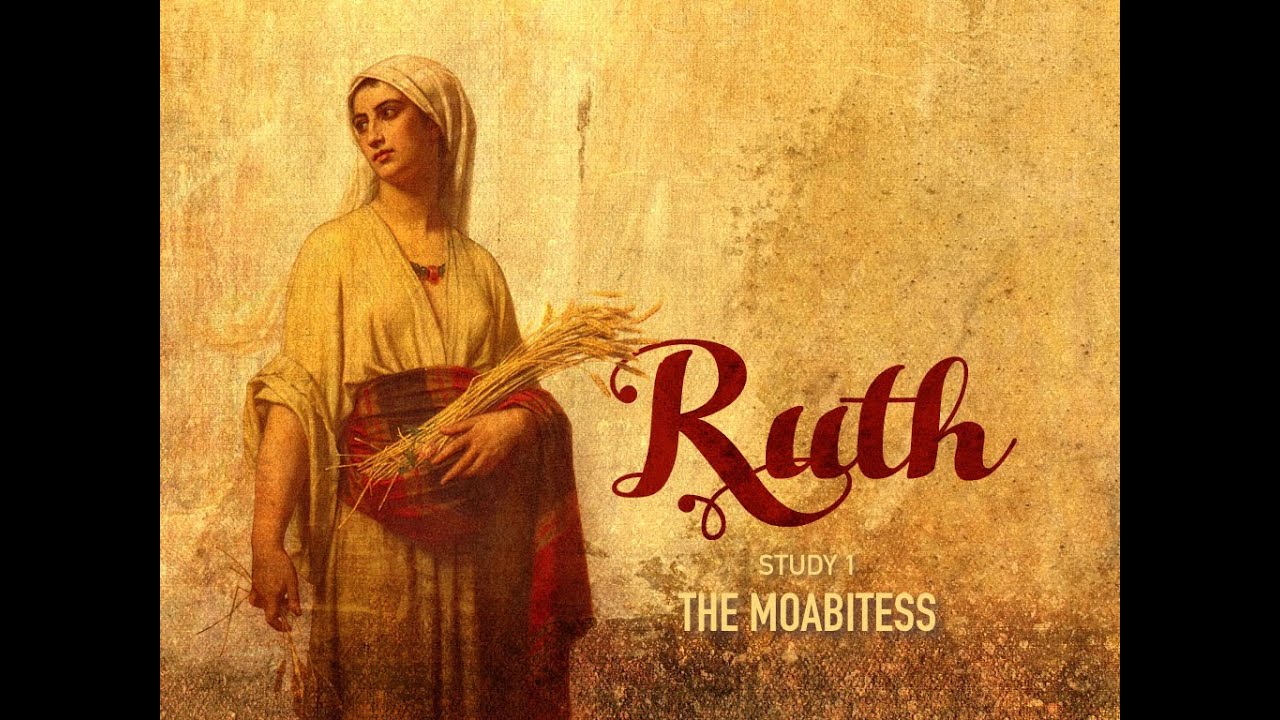
Some scholars point out that during the Joshua period, the Israelites killed and displaced the occupants of the entire land of Moab, and then reoccupied the land of Moab for themselves for 300 years - Ruth Was Israelite [10]. But it was still called the land of Moab. Reuben, Gad, and Manasseh were said to live in the "land of Moab". The displaced Moabites were enemies, so it doesn't make sense that Elimelech would go to live with them. According to Linda Watson [11], Ruth was a Moabite by geography, not by race. She was an Israelite living in Moab, though they probably worshipped other gods there.
Ruth makes a speech when Naomi urges her to return, her response is well known.
Ruth 1:16 (KJV) But Ruth said: “Entreat me not to leave you, Or to turn back from following after you; For wherever you go, I will go; And wherever you lodge, I will lodge; Your people shall be my people, And your God, my God.
See the words "shall be" in italics? That is a convention in the KJV to indicate those words are not in the original language. Most other translations don't let you know that. Usually it doesn't matter, but here it can change the meaning. In Hebrew, forms of "to be" (am, is, are) are left out in the present tense, so I could introduce myself by saying "I John", it is implied that it means "I am John". The phrase "your people SHALL BE my people" is different from "your people ARE my people". A few translations also say "your God WILL BE my God", which again is different from "your God IS my God. It sounds to me like Ruth is telling Naomi they are both Israelites, worshiping the same God. On the other hand, the Jewish Publication Society translates this verse with future tense, and they know their language better than me, so do your research and make up your own mind. Young's Literal Translation is the only one that sticks to present tense.
Ruth 1:16 (YLT) And Ruth saith, 'Urge me not to leave thee -- to turn back from after thee; for whither thou goest I go, and where thou lodgest I lodge; thy people is my people, and thy God my God.
Ruth's identity is hidden from the world just like Israel's identity is hidden from the world today - The “Lost” Ten Tribes of Israel…Found [12]. There are certainly Gentiles in the church, but it is not accurate to say the church is mostly Gentile or that Christ is marrying a Gentile bride.
One last piece of internal evidence. Moabites (actual descendants of Lot) were not allowed into the congregation of Israel for ten generations. It seems the nearer kinsman would have been justified in refusing to marry Ruth if she were a Gentile. This may not apply to women however - Ellicot's Commentary [13].
Deu 23:3 An Ammonite or Moabite shall not enter into the congregation of the LORD; even to their tenth generation shall they not enter into the congregation of the LORD for ever.
The Nearer Kinsman
 |
| Nearer Kinsman gives his shoe |
Observations
Knowing who pictures whom, consider these observations, courtesy of Chuck Missler - [6]. The observations are his, the commentary is mine. When you read Naomi, Ruth, Boaz; think Israel, Church, Jesus.
- In order to bring Ruth to Boaz, Naomi had to be exiled from her land
The northern kingdom of Israel was conquered and deported in 722 BC. The southern kingdom AKA Judah (the Jews) lasted till 592 BC, but a remnant was restored to the land of Israel - Jewish Virtual Library. The Romans destroyed Jerusalem and the Temple in 70 AD. Israel and Judah have been in exile since then until 1948. This roughly corresponds to the Church era.
- Ruth does not replace Naomi
Some teach that the Church has replaced Israel, that the promises to Israel have transferred to the Church. This doctrine, called Supersessionism or Replacement Theology, was developed before Israel became a country again, when those Biblical promises looked impossible.
"The Bible is filled with prophecies promising peace and wealth to Israel, and a great many are still unfulfilled, including a promise detailing specific borders, a promise of a King from the line of David, and a promise that Israel would one day be wholly devoted to God. " - Compelling Truth [15]
- Ruth learns of Boaz's ways through Naomi
The Old Testament has been faithfully preserved by the Hebrew people for 3500 years. The differences between the Masoretic text of Isaiah and the Dead Sea Scroll of Isaiah are incredibly minor even though they are 1000 years apart. Note too that the New Testament was written by Jewish authors (Luke excepted). Christian faith is based on a book written and preserved by Jews.
- Naomi meets Boaz through Ruth
Currently, the Jewish people do not accept Jesus as the Messiah or the New Testament as scripture (except for the Messianic Jews). But that NT says "And there is salvation in no one else; for there is no other name under heaven that has been given among men by which we must be saved." - Acts 4:12. Missler's point is that the Church will introduce Israel (particularly the Jews) to Jesus. But given the arrogance and antisemitism of the collective Christian churches over the last 1900 years, it is hard to imagine a scenario where the Jews will listen to Christians about religion. For more info, see Wiki(Antisemitism_in_Christianity) [16]. I don't know how and when the Jews will be introduced to the Messiah, and indeed they do expect Him shortly, but maybe He will introduce Himself personally.
- No matter how much Boaz loved Ruth, he had to wait for her move
God will not force salvation on anyone. Yes, there have been forced conversion through history, but do they really count? The point is, you have to ask. The Kingdom of God is voluntary.
- Boaz, not Ruth, confronts the nearer kinsman
Deut 25:9 says the woman who requests Levirate marriage and is turned down is to remove the man's shoe and spit in his face. But Boaz confronts the nearer redeemer himself - he does get the shoe, no record of spitting in his face. This simply means that Jesus will do the heavy lifting for us, that is, doing for us what we can't do for ourselves. Sometimes we have to "stand still, and see the salvation of the LORD" - Ex 14:13.
Future Fulfillment

Rev 5:9 "Worthy are You to take the scroll and to break its seals; for You were slain, and redeemed us to God with Your blood men from every tribe and tongue and people and nation.
These are some of the reasons to study the book of Ruth, Pentecost or not.
References
1. https://en.wikipedia.org/wiki/Shavuot
2. https://israelmyglory.org/article/ruth-and-boaz-the-story-of-the-kinsman-redeemer
3. https://ohr.edu/8234
4. http://superiorword.org/ruth-3-14-18-shesh-seorim-six-measures-of-barley/
5. http://www.abideinchrist.com/messages/lev25v25.html
6. https://www.youtube.com/watch?v=UkpV3tcENC8
7. https://servantofmessiah.org/hebraic-biblical-studies/ruth-type-gentile-bride/
8. http://www.biblicalthoughts.org/gentilebrides.htm
9. http://www.fivedoves.com/letters/may2011/elianeb530.htm
10. https://christogenea.org/podcasts/ruth-was-israelite-ruth-was-not-moabite-race
11. http://12tribehistory.com/was-ruth-a-moabite/
12. https://stevenmcollins.com/
13. https://biblehub.com/commentaries/ellicott/deuteronomy/23.htm
14. http://livingtemples.org/Ruth/ruth13.htm
15. https://www.compellingtruth.org/replacement-theology.html
16. https://en.wikipedia.org/wiki/Antisemitism_in_Christianity